
 Booksology
 Let’s begin with the clarifications. No, the two women are not in a romantic relationship. No, they are not renting an apartment together. They pooled their resources and jointly bought a place. In other words, their living arrangement is not a temporary solution but a stable, long-term commitment. These two women have, in defiance of societal and institutional norms, chosen to live together not just as roommates or friends, but as one unit — a family.
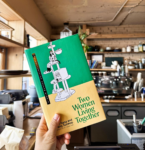
Meet Kim Hana and Hwang Sunwoo, authors of the memoir “Two Women Living Together,” recently translated into English by Gene Png. Single, in their 40s and “mothers” to four cats, they had both lived alone for years. When they bonded over shared interests, trips to the movies and boozy late-night chats, both were sick of doing everything by themselves and craving companionship. They also had one other thing in common: a firm conviction that marriage was not for them. They enjoyed singlehood too much to force themselves into glass slippers just as a cure for loneliness.
Realizing that they could be the solution to each other’s problems, Hana made a bold proposition. She’d already set her sights on a dream apartment, and Sunwoo was the one she wanted to buy it with. Several viewings, a hefty mortgage and a harrowing move-in later, the two women began to tread a path that no one around them had ever taken before.
First published in Korean in 2019, “Two Women Living Together” caused something of a quiet revolution. In a country where single-person households have become the predominant living arrangement, loneliness is an unsurprising epidemic. Yet, those who were used to being told that marriage would soothe their woes were treated to something much more powerful in Hana and Sunwoo’s memoir: another option.
Through earnest candor (Sunwoo) and affable wit (Hana), the two women put forth a calm but bold challenge to the age-old assumptions behind the word “family.” They gently show their readers that there are more ways to build a family than the most common one — a romantic union between a man and a woman.
An “assembled family” is how the authors describe their household. The term has a similar ring to it as “found family” or “chosen family,” reflecting the underlying idea that bonds of kinship don’t need to be formed through biological or legal connections but through intentional choice, shared values and mutual commitment.
In the real world, there are coldly pragmatic reasons for biological and legal ties to be treated as more permanent. Yet, as the book illustrates, the true glue holding relationships in place is commitment, not a piece of paper. To quote Hana, “The best partner isn’t someone whose lifestyle matches yours, but someone who is willing to put in the effort to create a lifestyle with you. With the latter, any conflict can be resolved.”
As is the case with many people who cohabitate, Sunwoo and Hana quickly realized that, though they had many things in common, household organization was not one of them. Where Hana was a minimalist with exactly one of every item, Sunwoo had a dozen body lotions lined up in her bathroom. Where Hana had a place for everything and always returned items to their rightful positions, Sunwoo left her things wherever she last used them, paying no mind to clutter in her living space.
It will come as a shock to no one that these differences drove the two women up the wall. When they first started living together, they would have screaming fights. A small thing would trigger an explosion: Waterworks erupted, doors were slammed, and phone calls ended abruptly.
As friends, the two could have called it quits and never spoken to each other again. As cohabitants, they could have chosen to forget their amicability and treat sharing accommodation as a mere transaction. As a family, however, they chose to put in the effort.
Hana abandoned her laser focus on cleanliness and learned to tolerate pockets of clutter. Sunwoo paid more attention to her belongings and tried to organize. Each time they mended their differences, they renewed their mutual commitment to the life they were building together, stitching up their family unit tighter than before.
Despite their personal success in redefining the rules of family, Sunwoo and Hana lament the lack of public and institutional recognition for relationships like theirs. Without legal endorsement, they are locked out of the merits enjoyed by married partners. They are unable to claim income tax benefits, for instance, or be registered as dependents under the National Health Insurance Service. Medical emergencies would present a challenge, as the right to act as a legal guardian is currently granted only to spouses or biological family.
Still, the story of two women and four cats forging their way past the headwinds of convention is a timely beacon. Because Hana and Sunwoo chose the path less traveled, others may be inspired to follow in their footsteps.
“Two Women Living Together” is available through dbBOOKS.co.kr.
Faye Leung runs @the_bibliocracy, an Instagram account dedicated to singling out reads for savoring. She regularly posts book reviews and recommendations, and has a particular fondness for Korean literature.


