
 Booksology
 Journalists have played a major role in the unfolding of the genocide in Gaza. Well over 200 Palestinian media workers have been killed by Israeli forces for daring to defy prime minister Netanyahu’s international ban on journalists in the Strip and for providing first-hand accounts of Israel’s assault on the people and infrastructure of an entire territory. Meanwhile, Israeli journalists – with a very few exceptions – have legitimised their state’s claims about the need to defeat Hamas and, in so doing, to inflict collective punishment on all Palestinians living in Gaza. This has involved reproducing calls for ethnic cleansing of the region and amplifying explicitly genocidal statements from leading politicians and generals.
Western media have played a no less central role in enabling the genocide by broadly affirming the position of their home governments in backing Israel’s murderous assault. This has involved humanising Israeli victims while dehumanising Palestinian ones, giving disproportionate time to Israeli spokespeople over Palestinian representatives, supporting Israel’s ‘right to defend itself’ while denying such a right to Palestinians, and employing differential – and less aggressive – language to describe Israeli, as opposed to Palestinian, violence.
This has been thoroughly documented in relation to the UK in two comprehensive reports produced by the Centre for Media Monitoring, the first of which examined all mainstream outlets while a later one focused on the double standards of the BBC. Daniel Trilling wrote a devastating critique of the BBC’s epic failure in reporting on Israel while Peter Oborne’s book on the UK’s complicity in the genocide provided detailed analysis of the media’s utter failure to report accurately or honourably on Israel’s actions. The investigative website Declassified UK has also reported extensively on the UK media’s pro-Israel bias and their general orientation towards dominant UK foreign-policy positions.
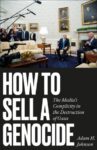
The same is true in the US where a number of outlets – including Zeteo, Drop Site News, The Nation and In These Times – have systematically attempted to hold the American media to account for their reporting failures on Gaza. One of the contributors to this type of media criticism is Adam Johnson who has now collated his analysis into a powerful and detailed book on the subject: How To Sell A Genocide. This sits alongside other impressive accounts of US media bias on Israel, such as Robin Andersen’s forthcoming Complicit Lens: US Media Coverage of Israel’s Genocide in Gaza, to provide an empirically rich critique of the full horror of the performance of American journalism on Gaza.
Johnson’s target is what he describes as the ‘center-left’ media, in other words those outlets closest, politically speaking, to Joe Biden, the occupant of the White House during the period of his sample, the twelve months following 7 October 2023. Largely ignoring the Maga media who were ‘openly genocidal against Palestinians’ (p.3), Johnson evaluates the content produced by more ‘liberal’ newspapers, broadcasters and platforms precisely because they paved the way for the justification by a Democratic president to arm and back Israel in its war on Gaza.
As such, the project resembles criticism that’s specifically focused on, for example, the BBC and the Guardian in the UK because of their role in mobilising centrist opinion to support Israel, rather than bothering with the self-declared Zionists at the Telegraph or Spectator.
Johnson has done his homework, carefully assessing 12,000 articles and 5,000 clips from both network and cable TV. The book includes (anonymous) revealing interviews with a range of journalists and some two dozen charts that illustrate in clear terms the scale of the bias against Palestinian perspectives.
Genocide, he states at the outset, was ‘enabled, facilitated, and cheerled by establishment US media providing cover for months of a nihilistic campaign of starvation, bombing, arbitrary detention, shooting, and sexual violence’ (p.2). The rest of the book maps out in great detail the various frames that US journalists used to justify, normalise and excuse the genocide (though of course that is not what they called it, nor were they allowed to call it that).
Johnson is especially good at challenging some of the dominant myths that were proposed in news stories in the first year of the genocide: for example, claims of ‘40 beheaded babies’, systematic rape carried out by Palestinians, the idea that UNRWA was riddled with Hamas supporters and that the Al Ahli Hospital was a command centre for Hamas itself.
He tackles the mobilisation of racist narratives against Palestinians as ‘uncivilized’ and ‘terrorists’, the smearing of the pro-Palestine campus protests, the policing of sympathetic journalists, the exclusion of Palestinian spokespeople from the airwaves and the utter hypocrisy of how Israelis and Palestinians were talked about when they were killed.
The book contains some astonishing data on the huge differences in how emotive language was used in relation to Israeli versus Palestinian victims. He finds that the New York Times referred 124 times to the ‘massacre’ of Israelis without once using this in relation to Palestinians in Gaza; for Associated Press, it was eighty to zero; and for the Washington Post it was fifty to zero. While there were 244 mentions of Israeli victims of rape (within a specific six-month reporting period) on CNN, there was one single reference to Palestinian victims; for MSNBC, it was 258 references to Israelis and one to Palestinians.
Johnson also addresses the openly Zionist views of corporate-media owners and highlights their various editorial interventions, for examples the memo to CNN staff demanding that they refer to the Ministry of Health as ‘Hamas-controlled’ or the direct meddling in the coverage of Gaza on CBS’s leading prime-time current affairs show, 60 Minutes. He is very clear about the stark differences between coverage of Ukraine and Gaza where genocide was routinely discussed in relation to the former and mostly ignored in relation to the latter. In terms of attributing violence without qualification to the offending states, he finds that Russian agency is ‘centered’ while Israeli agency is ‘obscured’.
How To Sell A Genocide is a very accessible text, free from academic jargon, and packed with different journalistic approaches or genres that Johnson often capitalises, including the fetish for ‘VERY SERIOUS INVESTIGATIVE PIECES’, ‘MOVE ALONG NOTHING TO SEE HERE REPORTING’ and the ‘NATURAL DISASTER-IZING OF ISRAELI WAR CRIMES’.
What I found particularly interesting was the book’s claim that this kind of mis-reporting matters – that it has real consequences. He suggests, for example, that repeated attacks on UNRWA (initiated by Israel but reproduced by US journalists) were designed to ‘make international aid that sustained life impossible to operate’ (p.90) and that repeated references to ‘Hamas strongholds’ were about the wish to ‘militarize the entire civilian population of Gaza’ (p.92) in order to justify collective punishment.
Mostly, however, Johnson advocates a more psychological perspective: that biased coverage in the ‘liberal’ media was effectively designed to make audiences ‘feel better’ about a war which, while they might be unhappy about in its everyday operations, they nevertheless broadly supported in terms of its overall ambition of ‘defending Israel’s right to exist’.
At times, this leads to some devastating pieces of writing. In relation to liberal nervousness about Israel’s use of starvation as a war aim, Johnson writes that ‘the New York Times, like the White House, wanted to feed Palestinians so they could be bombed on 60 calories a day’ (p.109). He concludes that liberal audiences simply wanted a more ‘humane war on Hamas’ (p.190).
At other times, the analysis feels a little narrow. There is little space afforded to history and context (for example, of Palestine itself or of the media’s coverage of Israel/Palestine over a longer period) that of course Johnson explains so clearly is absent from the coverage itself. The emphasis is very much on nailing the lies, distortions and omissions of mainstream-media coverage in relation to a particular political moment.
This also leads to a very pessimistic conclusion. Johnson concludes that the genocide, far from leading to a tipping point in relation to both Israel and Palestine’s place in the world, is likely soon to be forgotten. ‘I think the genocide in Gaza will be put into a memory hole, forgotten, dismissed as a lefty “obsession”, or hung up’ (p.203) and that, due to the complicity of the Democratic Party, there won’t be a full reckoning or indeed any meaningful degree of accountability.
Perhaps Johnson will be proved right. But how do you then explain the fact that, according to a recent poll, some 60% of American adults – rising to 80% of Democrat-leaning voters – have an ‘unfavourable’ view of Israel, a significant increase from last year? How do you account for the fact that more than one million Americans had taken to the streets in solidarity with the people of Gaza by the end of 2023? This chimes with the experience of the pro-Palestine movement in the UK which, in the last two and a half years, has helped not only to shift public opinion on Israel and Gaza but to give confidence to those journalists (admittedly small in number) who have struggled to overcome the barriers placed in their way when naming and reporting on the genocide.
Some of these journalists – or at least their US equivalents – are precisely the ones who spoke in confidence to Johnson to give him the valuable insights about which he writes so powerfully. Meanwhile, at the time of writing this review, Israel has killed yet another Arab journalist, Amal Khalil, this time in Lebanon with the BBC, as usual, reporting the IDF’s claim that it does not target journalists. Fewer and fewer people will believe this response; instead, they will be far more receptive to the examples and arguments mapped out with such great force in How To Sell A Genocide. That is another possible future worth highlighting.
Before you go
More war, escalating authoritarianism, a deepening cost of living crisis – the left faces big challenges.
But resistance is also growing.
Counterfire has been at the heart of the mass movements against war, in solidarity with Palestine, and against austerity. Given the scale of the crisis, we urgently need to ramp up our operations. We need your help to raise £30,000 to make that happen.
Please give generously – donate now.


