
 Booksology
 Rating: 4/10
I fell asleep reading this book.
Twice.
Now, let me preface this review with the disclaimer that I have historically not been a fan of Stephen King’s corpus. His novels are, for me, exactly that: corpses.
They are vessels in which the fundamental skeleton is present, but the essence, the life, is wholly absent.
Is this an unpopular opinion? Very much so, if his crowning as the “King of Horror” is any indication to go by.
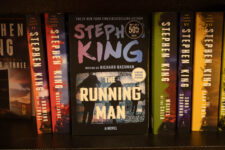
“The Running Man” is actually the first of King’s books that I read from cover to cover. Prior to this, the closest I’d ever gotten was when tackling “The Shining” — arguably one of King’s most acclaimed works — while on a plane.
I was trapped in a metal cage, suspended in the air for just over nine hours, and yet it was the sluggish pace of King’s plain prose that had me feeling truly imprisoned. I made it roughly 80% of the way through, and even my desperation to pass the time wasn’t compelling enough of a motivation for me to drag my jaded mind through one more paragraph.
At that point in the book, I could just make out the light at the end of the tunnel, but it was ultimately neither bright enough nor enticing enough to justify trudging through the dark and twisted maze of King’s imagination.
And I’m sorry, Joey Tribbiani, but there was absolutely no need for that book to be sequestered in the freezer; the scariest aspect of my experience reading “The Shining” was when my Kindle slipped out of my hand as I began to drift off.
Fortunately for “The Running Man”, King limited the premise to a digestible length of about 230 pages. Though quite uncharacteristic of an author showered with accolades for writing 1,000-page behemoths, the decision was nonetheless very much appreciated by this self-proclaimed King critic.
All in all, I think it would be safe to say that I didn’t exactly dive headfirst into this literary venture with high hopes. Indeed, my low expectations ended up being my saving grace, for the fall was very manageable — about as impactful as the book’s supposed commentary, which is to say not in the least.
If you’ve seen the trailer for the upcoming cinematic adaptation, starring University of Texas student Glen Powell as the titular “running man,” you may have gotten the impression of a cut-and-dry action flick with a generous sprinkling of slapstick humor.
Powell’s definitely got nothing on his “Top Gun: Maverick” co-star Tom Cruise in that field, but I digress.
If that characterization of the movie proves to be accurate, then it will be all the better for the filmmakers’ financial spoils, as any faithful adaptation of “The Running Man” would surely drive audiences away with its depressing depravity and lack of a fleshed-out storyline.
The blurb on the back cover of the novel is certainly promising enough: Down on his luck in a totalitarian society in the not-so-distant year of 2025, the desperate protagonist, Ben Richards, joins a deadly televised program in which he must evade capture at the hands of hunters to earn the grand payoff.
Was this book reminiscent of Richard Connell’s “The Most Dangerous Game?” Absolutely, especially as it touched upon themes of class disparity and dehumanization.
Did it seem like Suzanne Collins’ “The Hunger Games” on sadistic steroids? Also yes, most notably in the way that an oppressive regime and the exploitative manipulation of the media took center stage.
But could “The Running Man” be considered a must-read for any literary element beside the social critiques that were piled upon the reader by the heaping paragraphful? Not in my book.
The most blinding issue I had with this novel — and King’s work as a whole — was the overwhelming writing style, which, paradoxically, left a lot to be desired. Somewhere between the absence of any world-building and the excessive mundane imagery, there was so much thrown at me that it felt akin to being dropped inside a fever dream.
With the story being written from the third-person perspective, I also felt very detached from the narrative; I was a passive onlooker as opposed to a champion of the masses alongside Richards, whose “rebellion” was essentially just his sparkling personality shining through.
And though King is often lauded for prioritizing character development over plot progression, Richards was pitiful from start to finish. Rather than a multi-dimensional personage with which the reader could empathize and root for, King created a brash and unhinged figure to spearhead his book.
Of course, all these details I’ve vilified are undeniably symbolic. Richards was the stone that became the chisel; the stark prose reflected the dreariness of society and its prospects; the lack of syntactical embellishment mirrored the absence of hope in a world stripped down to its bare bones.
Perhaps I’m just not pessimistic or philosophical enough, but I would argue that King painted a picture so abstract with his words that countless hidden details were lost in translation, and consequently, his chef-d’œuvre just fell flat.
And because he focused so heavily on conveying his message, the supporting — yet equally crucial — content was neglected. Personally, I would’ve entrusted Michael Crichton, Lee Child or James Patterson with bringing the brilliant concept of “The Running Man” to life.
So, was the novel a page-turner? Definitely.
But only because I was rushing to reach the finish line.
Maeva Elizabé is a neuroscience junior and chemistry minor and opinion writer for The Battalion.


