
 Booksology
 ‘The owl of Minerva only takes flight at dusk,’ wrote Hegel, reflecting on history. By this, he meant that a true understanding of historical events often emerges only in retrospect, after their immediate impact has faded. Perhaps this is because of the polemical noise surrounding such momentous events. This phenomenon is particularly evident when trying to comprehend a political group like Hamas.
In May 2024, Just World Education organised a series of webinars in an attempt to provide an objective discussion and analysis of Hamas and its historical development. The webinars featured five academics: Dr. Paola Caridi, Dr. Khaled Hroub, Dr. Jeroen Gunning, Mouin Rabbani, and Dr. Azzam Tamimi, all of whom are peer-reviewed experts in their field.
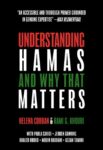
The result of these conversations is a collection of probing discussions and transcribed lectures, collated into Cobban and Khouri’s Understanding Hamas and Why That Matters. The aim of this collection is to provide an essential overview of Hamas’s complex history and inherent contradictions, offering an objective analysis of its activities. The book intends to move beyond mere moralisation and condemnation, enabling a deeper understanding that is vital for pursuing non-violent, political solutions and fostering an anti-war perspective on the conflict in Palestine.
A major theme of the book is discussing Hamas’s historical development. The book strongly refutes the misconception of Hamas as a static organisation with unchanging aims and practices. Instead, it points out that the organisation has consistently adapted and evolved as time has progressed, demonstrating a capacity for strategic shifts in response to changing geopolitical landscapes, internal Palestinian dynamics, and Israeli policies.
This argument is put forward best by Dr. Paola Caridi who describes Hamas as a pragmatic movement with a rigid structure and decisional process (p.5). It is this fundamental contradiction that shapes the historical character of the organisation.
Hamas’s pragmatism stems from its strategic flexibility, particularly concerning its ability to negotiate (p.22). Dr. Caridi highlights its willingness to negotiate with Israel since its inception in 1988, citing a visit to Tel Aviv for negotiations with the Israeli leadership and again with the 2011 prisoner exchange. Caridi also points out their willingness to negotiate on behalf of the Palestinian people, stemming from a desire to be legitimised by the Palestine Liberation Organisation (p.23). This point is further supported later in the book by Jeroen Gunning noting their ability to compromise and impose ceasefires and lead hostage exchanges, citing 1996, 2006, and 2017 in particular (pp.71-2).
Dr. Caridi further evidences Hamas’s ideological pragmatism in the transition between its 1988 Charter and its 2017 Document of General Principles and Policies (p.24). Where the initial Charter framed the conflict as a religious struggle, advocated the destruction of Israel, and made no distinction between Jews as an ethno-religious group and Zionists as adherents to a political ideology, its 2017 document compromised on a two-state solution, adapted its analysis to an anti-colonial struggle, and differentiated between Judaism and Zionism following national political engagement.
Despite this being pointed out as an adaptation, Dr. Caridi (p.24) is quick to note that the 1988 Charter has not been outright rejected, owing to the rigidity of Hamas’ decision-making process. This results from a need for consensus, ideological symbolism and gradual pragmatic adaptation to unite the organisation.
A further tension is noted in the discussion with Dr. Khaled Hroub, who identified the rotating contradiction between Hamas’s Islamic and nationalistic tendencies (p.41). For Hroub, depending on circumstance, one of these binary elements can take the ideological lead within the organisation at different times. When negotiating or tackling political issues in the region, it is usually the nationalist tendency that leads the discourse, approaching the issue in a secular way. Hroub once again cites the 2017 General Principles noting its language and definition of Palestinian territory being lifted from Palestine Liberation Organisation literature due to its popularity amongst Palestinians (p.58). By contrast, when the organisation is dealing with social networks, charities, or appealing to its Muslim constituency, the religious tendency takes hold.
A final contradiction noted in the book is identified by Dr. Jeroen Gunning, who observes the organisation’s fluctuation between authoritarianism within its structures and its more democratic leanings, depending on circumstances (p.80). Gunning notes Hamas’s tendency to consult with and be swayed by the wider population on some issues, such as the 2003 and 2005 ceasefires. However, it has retreated to its autocratic roots, pushed by its military wing, following Fatah’s failure to recognise the 2006 elections.
A further key element elucidated in the book is the politicisation of the term terrorism, particularly how it is often deployed to close down meaningful discussion and nuanced understanding of groups like Hamas. As Dr. Jeroen Gunning highlights in his contributions to the discussion, the act of labelling actions as terrorism strips violence of its essential historical and political context. This reductionist approach not only oversimplifies complex conflicts but also proves counterproductive, offering no viable political solution to conflict beyond the perpetual cycle of indefinite military intervention or pervasive surveillance policing (pp.68-9). Crucially, such a label effectively shuts down any constructive conversation that could lead to genuine, diplomatic resolutions (pp.68-9). By framing the issue solely through the lens of terrorism, the underlying grievances, political motivations, and socio-economic factors that contribute to violence are systematically ignored, making pathways to a negotiated settlement appear impossible and perpetuating the conflict rather than resolving it.
In a crucial concluding remark, Dr. Khaled Hroub distinguishes between Islamic State, Al-Qaeda, and Hamas, arguing that Hamas is fundamentally a nation-based organisation, in contrast to the other two whose aims he describes as vaguely defined by comparison (pp.61-2). This suggests that despite Hamas’s contentious methods, its nation-centric focus means it represents a political entity with concrete, geographically specific demands and objectives. These are, by their very nature, grievances and aspirations that could potentially be addressed through conventional political and diplomatic means. This stands in stark opposition to the amorphous, transnational ideological warfare waged by groups like Islamic State and Al-Qaeda, whose expansive and ill-defined objectives inherently offer no clear pathway to a negotiated settlement or lasting peace.
The collected discussions found in Understanding Hamas and Why That Matters offer a counter to simplistic portrayals of Hamas. Though the book is short, its attemptto seek a nuanced comprehension of the organisation is welcome if the aim is achieving a just and peaceful resolution to the Israeli-Palestinian conflict.
Whilst the introduction of book states it wants to be accessible to readers who may or may not have a deep understanding of the conflict, the authors do assume a baseline familiarity with the conflict’s complex history, key political actors, and enduring issues which may be difficult when introducing someone to the topic. Whilst the book sticks to its aim in demystifying Hamas, its detailed discussions on the group’s evolution, internal dynamics, and strategic shifts lack sufficient foundational context for a complete grasp if someone is unfamiliar with the broader historical timeline. Without this background, readers might struggle fully to appreciate the significance of Hamas’s strategic decisions, the nuanced tensions between Islamist and nationalist ideologies, or the profound implications of terms like ‘settler-colonialism’ within the conflict’s narrative.
The book is, however, useful in detailing Hamas’s historical evolution, highlighting key shifts from its initial focus on social and religious activism to its national political engagement, culminating in its 2006 electoral victory. It also dissects the intricate balance between Hamas’s political and military wings, illustrating a dynamic interdependence that allows for both strategic leverage and disciplined action. The book further demonstrates how understanding Hamas’s structure can lead to de-escalation by enabling the identification of key decision-makers and points of influence within its complex system, allowing for more targeted communication, negotiation, and policy interventions.
Another key aspect explored is the transformation of Hamas’s ideological stance: moving from the problematic, often antisemitic language of its 1988 Charter, which conflated Jews with Zionists, to the more pragmatic 2017 document that explicitly differentiates between Judaism as a religion and Zionism as a political project. This nuanced analysis reveals Hamas not as a static, irrational entity, but as a complex actor capable of strategic adaptation, operating within a ‘rigid structure and decisional process.’
Finally, the book is also useful in providing a contextual understanding of Hamas, cutting through ideological labels aimed at justifying imperial interventions. Its portrayal of Hamas as a ‘nation-based organisation’ engaged in a struggle against settler-colonialism resonates with an anti-imperialist framework, viewing their resistance as a response to the material plight of the Palestinian people as opposed to representing abstract evil.
Understanding Hamas and Why that Matters is available from O/R Books.
Before you go
The ongoing genocide in Gaza, Starmer’s austerity and the danger of a resurgent far right demonstrate the urgent need for socialist organisation and ideas. Counterfire has been central to the Palestine revolt and we are committed to building mass, united movements of resistance. Become a member today and join the fightback.


