 Booksology
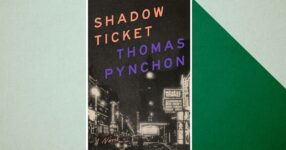
 Shadow Ticket by Thomas Pynchon (Penguin Press) is out October 7.
Photo-Illustration: Vulture; Photo: Penguin Press
Shadow Ticket starts with a bang. “The explosion when it comes seems to be from somewhere across the river and nearer the Lake,” Thomas Pynchon writes. “Nobody seems surprised.” In language and sentiment, the lines closely echo the opening of 1973’s Gravity’s Rainbow, his best-known book: “A screaming comes across the sky. It has happened before, but there is nothing to compare it to now.” Both are about bomb blasts, expectations, and — if you squint — war. Shadow Ticket depicts the path to Gravity’s Rainbow’s phantasmagoria of World War II horrors, and none of the book’s characters is confused about the sadistic direction things are heading.
At 88, Pynchon has written his most urgent novel yet thanks to a newfound narrative grounding that maintains his distinctive style of cartoonish maximalism and high-flown beauty. It is filled with his famously overstuffed paragraphs, often one thrumming sentence each. But his words go down a bit more smoothly than usual without sacrificing any of his crackle. The result is a Pynchonian reduction simmered to delectation.
Set in bustling Milwaukee and a troubled expanse of Central Europe during the Depression, the tail end of Prohibition, and the long eve before WWII, the novel is about rising fascism — both abroad and at home. Hicks McTaggart, a reluctant private eye riding the industry’s transition from strikebreaking (labor suppression was once a major part of the private-detective business) to investigating cheating spouses, gets swept up in a case concerning the bombing of a bootlegger’s hooch wagon. Helpfully, or so it seems, Hicks’s uncle leads him to New Nuremberg Lanes, a speakeasy–bowling alley that doubles as the local headquarters of the American Nazi movement. When the Feds bust in under the pretense of an alcohol raid, they begin to coerce Hicks into helping them with their own murky investigations. Partly to escape the heat, Hicks accepts a job to track down Daphne Airmont, the daughter of a mobbed-up Wisconsin dairy kingpin, “the Al Capone of Cheese.” Daphne has disappeared with a Jewish swing clarinetist instead of marrying a rich “onetime male flapper somehow delivered into premature middle age.” She and her father, it turns out, have separately fled to Europe. Jerked around by international intrigue he doesn’t fully understand, Hicks ends up in Greater Hungary trailing both of them — and falling into any number of side quests — as the Holocaust comes directly into view.
It’s no coincidence that Hicks’s Hitler-venerating uncle is a cop. One thread of Shadow Ticket is the post-Prohibition emergence of the FBI and a new paradigm of law enforcement that — like some of the soon-to-be Allied governments these agencies serve — is chiefly interested in protecting the liberal capitalist order, and often complicit in the growing Nazi powers. “This is the next wave of Feds you’re talking to,” an agent tells Hicks. “We haven’t even begun to show how dangerous we can be.” It’s one of Pynchon’s longtime hobbyhorses: 1990’s Vineland features a “former Nazi Luftwaffe officer and subsequently useful American citizen” leading federal marijuana busts in “the full regalia of his old profession.” Gravity’s Rainbow is in part a book-length satire of Operation Paperclip, the U.S.’s secret program that brought Nazis to work on V-2 rockets and other military research.
Shadow Ticket’s setting is a time of “lost people, lost hope,” an era of myriad attempts by Europeans and Americans to recover the losses of the Great War and the Depression, of the perceived bereavement in nostalgic Nazi narratives. Mass media, especially the newly widespread radio, is pushing young Americans to marry and procreate. The global spiritualist movement is in its end days, even though it’s still going strong in Hungary. Several characters seem to inhabit a zombie limbo between life and death. Objects are sometimes transported across time and space through a kind of stage magic operating in real life. All of this movingly literalizes the “geopolitical ghost stories” and overwhelming sense of loss permeating every corner of the book.
Despite the intensity of his subject matter, Pynchon remains hilarious. Most of the book’s roughly 100 characters have names worth at least a smirk, including Thessalie Wayward, Boynt Crosstown, and Don Peppino Infernacci. The acronyms, another staple, are even more playful: IMOPIO (Infernal Machine of Presumed Italian Origin), SMEGMA (Semi-Military Entity Greater Milwaukee Area), UTOPIAN (Unless the Opportunity Presents Itself Attack Nobody).
And his descriptions of physical comedy are as vivid as ever. One character turns his head “so fast his hat slides off of it.” An Interpol cop ordering Hicks around Europe has “hauled an oversized soup spoon out of someplace and begun energetically to shovel cocaine into both nostrils at once.” Pynchon’s absurdism is his way of grappling with and undermining the awful too-muchness and stupidity of it all — especially of the American project and its many tentacles. If everything is systematically interlinked, then life’s transcendent beauty is inextricable from its inexpressible horrors and outright silliness, like the jarring swings between slapstick and tragedy in a Wile E. Coyote cartoon. Not for nothing did Pynchon, in one of his only media appearances, call Homer Simpson his role model.
But the pratfalls and dick jokes are never far from a radiant paragraph in which he zooms out and pans around, wringing emotion from the view. In Chicago, taxis emit “exhaust brightening visibly into the air like the breath of coach horses not that many winters ago.” Pynchon reenvisions breezy gusts as music from a ghostly instrument associated with the book’s era: “a continuous wind outside, down from the high limestone, a theremin of uneasiness, sliding around a narrow band of notes, in which it’s said you may come to hear repeated melodies, themes and variations, which is when you know you’re going bughouse, with only a very short period of grace to try and escape before it no longer matters.”
Shadow Ticket is also concerned with what it means to settle down with someone amid a rising fascist movement that pushes normative ideas of family and conformity. Hicks is annoyed when he’s assigned relationship cases, which require a more complex emotional labor than, say, looking into a bombing. (Appropriately, his chief romantic interest has a thing for married men.) But as the plot develops and Hicks matures, he begins to come around to an alternative view of companionship as bulwark against the troubled times. Far from being a private pleasure of conformity, Daphne’s relationship propels her into the anti-fascist resistance when she has to rescue her boyfriend from a gang of Hungarian Nazis.
I haven’t even mentioned the 2,000-kilometer motorcycle rally through Nazi-soaked “Hungary Unredeemed,” the former WWI U-boat that follows the book’s action from Lake Michigan to the Adriatic, or the geopolitical machinations of the International Cheese Syndicate. “Ahhhgghh!” a character interrupts late in the book as a particularly egregious non sequitur begins. “Do we have time for this?” It’s a continual question with Pynchon. While there was a pleasure in the earlier bagginess, it could sometimes feel nearly impossible to grab hold of everything going on. In Gravity’s Rainbow and Vineland, scores of pages go by before the narrative reconnects with the characters who initially appear to be protagonists. Mason & Dixon spends long stretches following characters besides Mason or Dixon. Shadow Ticket embraces Pynchon’s maximalism, but the perspective basically always follows Hicks. This grounds the reading experience, giving us a through-line amid the chaos.
This is a period novel, filled with reams of textured historical details so absurd that they can seem invented specifically for Pynchon’s own delight. “Are you telling me this stuff is all a variety-house routine, that it doesn’t … really happen?” Hicks asks at one point. That’s some heavy authorial winking, as so much in Shadow Ticket actually occurred. Some of my favorites include Milwaukee’s “straw box” shelters where napping cops escaped the cold; the Jell-O molds in the shape of American landmarks like the Statue of Liberty, given to immigrants passing through Ellis Island; and the poisonous radium fad of the early 20th century, with products touted for their glowing radioactive ingredients.
This temporal displacement frees Pynchon to offer sidelong commentary on contemporary politics without getting trapped in the flux of the present or being too on the nose. He writes of the U.S. as “a country not yet gone Fascist” — the yet suggesting a someday will — and of “the long and slowly deepening twilight of our nation’s history.” In a rare direct address to the reader, he despairs that “we’re in the last minutes of a break that will seem so wonderful and peaceable and carefree. If anybody’s around to remember.”
As a late-career statement, Shadow Ticket is no surrender to the darkness; Pynchon delivers a trenchant plea that we not wait for the obvious conclusions of hindsight to acknowledge what the present demands of us — making explicit the morals that have always undergirded the cerebral irony of his work. He writes of two options available when facing the events of the 1930s — or the 2020s. Either you turn inward toward marriage, family, and a “life you can persuade yourself is free from fear,” while those you could have helped “are one by one robbed, beaten, killed, seized and taken away into the nameless, the unrecoverable,” until you realize, too late, what you should have been doing all along. Or you don’t have to wait.
Thank you for subscribing and supporting our journalism.
If you prefer to read in print, you can also find this article in the October 6, 2025, issue of
New York Magazine.
Want more stories like this one? Subscribe now
to support our journalism and get unlimited access to our coverage.
If you prefer to read in print, you can also find this article in the October 6, 2025, issue of
New York Magazine.
See All