
 Booksology
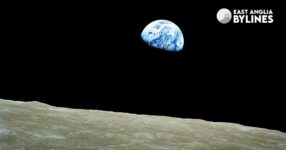
 An airport departure hall is perhaps not the best place to be reading a book with this cover. Once aloft though, the view across a cloudless landscape is a good companion to it. Both are reminders of how small each individual human is and the impact we, collectively, have on the planet that homes us.
Dr Henry Gee is a senior editor at Nature. He has written books with topics ranging from The Science of Middle-earth to a prize-winning overview of the history of life on earth. So, you might expect writing that accessible to a layperson, backed up with scholarly evidence for his information. You would be right.
Each chapter of the book is headed by a short extract from Gibbon’s History of the Decline and Fall of the Roman Empire. Gee draws parallels with that empire and our world today, discussing how success contains the seeds of eventual failure.
I thought I knew a little bit about human evolution and on reading about it here, I realise that is all I knew, just a little bit. The part dealing with how hominids populated the globe is fascinating. The various species of Homo emerged from Africa, their ranges expanded and contracted with environmental changes.
Populations went through bottlenecks and species both competed and intermarried. You probably already know that unless you are African, you carry a tiny proportion of Neanderthal DNA. However, Homo sapiens is a remarkably homogenous species, less diverse genetically than a single troop of chimpanzees.
He presents a statistic that should make everyone think. A statistic the implications of which should be beaten around the head of every politician and news editor who presents immigration as a bad thing.
In the late 1960s, the rate of growth of the human population started to slow. Not the growth of the population overall, but the rate of growth. To maintain a population at its current level requires each woman within it to produce 2.1 babies. On average, of course.
Western societies are no longer achieving that level though. National populations continue to grow because people are living longer, and from immigration. Eventually though, even countries which do still have higher birth rates will see those drop below replacement level. The implications of an aging population are already well known, with fewer people of working age paying taxes to support those who can no longer work. Working age itself is being extended upwards, with the increase in retirement age.
Nearly 50 years ago now, I learnt in Social Sciences 101 (literally, that was the number of my first Open University course) that immigration results in an influx of people of working age who immediately start contributing to society before eventually drawing on state resources in the shape of children’s education and old age pensions. That is, if we don’t park them in horrible accommodation, refuse them permission to work and treat them like pariahs. Oops, back to the book review…
In the Prologue, Gee argues that every species faces eventual extinction and Homo sapiens is no exception. We are at a unique turning point, facing not the extinction of a single group, but, eventually, our whole species.
While he doesn’t see that happening for some thousands of years, Gee sees it as essential that we start thinking about this now, before the population drops below a critical threshold needed to throw up great innovators who might invent a way out for humanity. His argument is that the existence of a few brilliant minds needs a huge population to produce them.
I wonder, though, is that really so? Once upon a time someone hit a rock with another rock and made a sharp edge; much later a small group of people decided to plant some seeds of a high-yielding grass. Those developments happened when the population of the planet was tiny, but they are the innovations that laid the groundwork for today’s world.
The rate of technological change – innovation – is accelerating all the time – over a million years from stone tools to agriculture, 10,000 from agriculture to now. That acceleration has gone hand in hand with the growth in population, but I wonder whether a drop in population would necessarily result in a drop in its ability to innovate.
Given Gee’s suggested solution to saving humankind from extinction, the real issue is slightly different. A huge population is needed to provide the resources to realise that solution. Because in the final part of the book Gee suggests the way to avoid extinction is to colonise space.
It’s a brilliant and sustained thought experiment, one that makes me want to have a face-to-face discussion. Although, I suspect I would lose in any debate with Gee, given the breadth of his knowledge.
Disclaimer: I have met Henry Gee twice, years ago when he gave a talk at Science in the Pub, and again at the launch of this book.
The Decline and Fall of the Human Empire is available from bookshops and Amazon, where you can read a sample.


