
 Booksology
 Wilfred Burchett is today rather forgotten but during the Cold War he was a controversial figure. An Australian journalist, he was the first to report from Hiroshima on the awful effects of radiation after the US atomic bomb was dropped. His press accreditation was immediately withdrawn by the Americans and he had to leave Japan immediately.
He went on to report from North Korea during the Korean War, including interviewing American PoWs. For that, the Australian government rescinded his passport. It took him over twenty years to get it back. Burchett would go on to report from North Vietnam in the 1960s.
Politically he was more than a Communist fellow traveller. He championed the Soviet Union in the 1950s, writing for the press of the French Communist Party. In the 60s, he would side with Beijing after the Sino-Soviet split. His politics were a mixture of Stalinism and Third Worldism, seeing the national-liberation struggles of the 1950s and 1960s as being the key challenge to the imperial order.
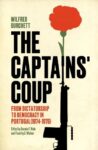
The Captain’s Coup is his account of the April 1974 military coup in Portugal which overthrew the decades-long fascist dictatorship and unleashed a military crisis. It begins with him just managing to get on the first plane from Paris, where he lived, to Lisbon after the airport there re-opened following the coup. It is worth reading the book simply for his description of arriving in Lisbon, visiting the bank and booking in at his hotel to get a taste of the revolutionary events which followed so quickly from the military takeover.
Because Burchett’s writings on Vietnam had been published, escaping the fascist censor, he got access to central figures in these events, especially the captains who led the coup. The most interesting is ‘Otelo’ Saraiva de Carvalho. Born in the Portuguese colony of Mozambique, Otelo spent many years in the colonial wars in Africa. He served in Portuguese Angola from 1961 to 1963 as a second lieutenant, and as a captain from 1965 to 1967 and then in Portuguese Guinea in 1970 as a captain.
In the book, Otelo describes how we was radicalised in Africa. It was obvious Portugal, the poorest, least developed country in Western Europe, could not win the colonial wars which had begun in the 1960s. He was appalled by the racism of the Portuguese settlers and like other officers was encouraged to read Mao Ze Dong, Che Guevara and Ho Chi Minh, so as to better understand the guerilla war their enemies were fighting.
Burchett describes how Otelo and other junior officers were influenced by the guerilla movements they had fought in Africa. Back in Portugal, he was the strategist behind the military takeover of Lisbon, the capital, and would head a new force, Copcon, which was charged with defending the new democracy created by the Armed Forces Movement (MFA), the organisation of junior officers behind the Carnation Revolution. The carnation was the symbol of the revolution worn by soldiers, even placed in their gun barrels.
The book has further interest because Burchett didn’t stay in Lisbon but went into two key agricultural regions; the Alentejo in the south, dominated by latifundia and where land seizures would spread; the second area was Trás-Os-Montes in the mountainous north east where small peasant farmers struggled to make a living and their children quit for Lisbon or Porto or to Germany, France and the UK. What he describes in these regions is an almost feudal society with dire poverty, illiteracy and absentee landlords who did little to improve their estates. As the revolution developed, Alentejo would be a militant centre, while in Trás-Os-Montes, the Catholic Church would whip up anti-communism.
The book, however, has a central weakness in that Burchett accepts the line of the Portuguese Communist Party (PCP), which was a major force, having been key to the anti-fascist struggle under the dictatorship. Emerging from illegality after the Carnation Revolution, it was the key force in the new trade unions.
Burchett praises its strategy, ridiculing the ‘ultra-left’ which had also emerged. But the PCP was fervently loyal to Moscow, no Euro-Communism there. Moscow stood by the 1945 Yalta and Potsdam agreements whereby Europe was divided into spheres of influence. The USSR got Eastern Europe but Portugal was in the US/UK sphere. In 1974 and 1975, as a full revolutionary crisis developed, the PCP was clear that socialism was not on the agenda, even at the beginning trying to limit strikes.
Burchett accepts this and the theoretical analysis underlying it that Portugal was effectively a colony of the US and northern Europe. As mentioned, it was the poorest, least developed state in Western Europe and multinational capital was present in strength. However, apart from the fact that it had a colonial empire, it’s obvious even in The Captain’s Coup that there was an indigenous capitalism, so that analysis was only ever a partial one.
The Captain’s Coup was written in 1974 and early 1975. It does describe two mass mobilisations involving workers, the armed forces and landless labourers in stopping two attempted right-wing coups.
There is a second, shorter piece written in 1976 after the situation had stabilised. In November 1975, the moderates in the MFA took over after they had claimed left-wing units had tried to stage a coup. What had happened was that those units, generally influenced by the PCP, threatened a coup in an attempt to influence the intra-governmental conflicts in favour of the Communists, but it backfired badly. Burchett does not admit this, or blame the PCP, but once again lays the fault at the ‘ultra left’.
The book ends with a piece Tariq Ali wrote in 1978 after it was clear November 1975 had been not just a turning point in Portugal but part of a wider shift as Western European capitalism stabilised and turned the tide on the post-1968 working-class insurgency.
It argues that after five decades of fascism, the Portuguese working class and rural population were not going to shift all the way over to revolution. In the 1930s, both Leon Trotsky and Antonio Gramsci had argued that if fascism fell in Italy the masses would follow ‘common sense’ and look to restore democracy. They both argued that revolutionaries should support a constituent assembly and a referendum and fight for radical democratic demands. In Portugal, the big winner after the Carnation Revolution was the Socialist Party because social democracy was the common-sense option for a population emerging from fascism.
I would argue with Tariq on this issue, because he is overly dismissive of the far left, which had a degree of working-class support, for instance the Revolutionary Party of the Proletariat (PRP) in the important Setubal car plant. Yes, the PRP made mistakes and had some awful positions on some issues, but in retrospect so did many groups.
In November 1975, as the situation stabilised in Portugal, across the border in Madrid, General Francisco Franco died after 36 years of heading a fascist dictatorship following his brutal victory in the Spanish Civil War. Tariq and I were in the same organisation and our line was that fascism could only be ended in Spain by a revolutionary general strike. How wrong we were. For all my criticisms, this is a book well worth reading. It’s a fairly unique English-language report from inside the revolution.
Before you go
The ongoing genocide in Gaza, Starmer’s austerity and the danger of a resurgent far right demonstrate the urgent need for socialist organisation and ideas. Counterfire has been central to the Palestine revolt and we are committed to building mass, united movements of resistance. Become a member today and join the fightback.


