 Booksology
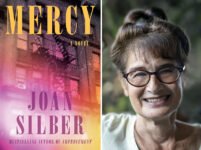
 In case you only read the first paragraph of this review, I’ll start with the takeaway: If you have never read Joan Silber, it is time you did. Silber has been a critical darling since she won the Hemingway/PEN prize in 1980 for her debut, “Household Words.” More recently, “Improvement” (2017) won both the National Book Critics Circle and PEN/Faulkner prizes. Despite these and other honors, Silber still flies somewhat under the radar. And yet the same readers who have made Ann Patchett, Elizabeth Strout, and Jennifer Egan household names would love her. If you are in this group, allow me to recommend “Mercy,” Silber’s 10th book of fiction, as a jumping-off point for her delightful oeuvre.
It could be that one of the things that’s so great about Silber’s work is also responsible for her cult status. Like its predecessors, “Mercy” is a novel-in-stories, a single fictional universe with a rotating cast of narrators, connected by threads of plot and meaning that unfold over the course of the book as they would in a novel. At the same time, the sections leap decades and continents to uniquely dazzling effect.
“Mercy” has six sections, one for each of its main characters. We meet three of them in the first story, which is narrated by Ivan, who looks back some 50 years to his misspent youth in New York City of the 1970s when asked by his college-age daughter what’s the worst thing he’s ever done. “Lying to your mom about liking her kale salad,” he tells her.
But to us, the reader, he will tell the real story. This tone of intimate confiding runs all through the book: Every narrator will share the truth about things they hide from other people, reminiscing about their past adventures and misadventures in a conversational tone that really feels like you are being directly addressed — like a late-night phone call from an old friend, is how the critic Ron Charles so aptly put it.
Ivan’s story is a drug-a-logue of a type we haven’t run into in a while, since back in the days of “Permanent Midnight” and Edward St. Aubyn. The worst thing he ever did happened the night he and his best friend Eddie and Eddie’s girlfriend Ginger shot heroin, and Eddie overdosed. Ivan dragged him over to the emergency room of St. Vincent’s Hospital, but left him on his own in the waiting room, fearing that unpleasant consequences might unfold. And from there he just kept going, never finding out what happened to Eddie, even whether he lived or died, and never getting back in touch with Ginger, either, though he sees her on television years later.
He may have lost track of them but we will not. The next section of the book belongs to Ginger, though she has stopped using that nickname and goes by her real name, Astrid. She has a lot of news — though Eddie was arguably the love of her life, he was followed by three husbands, two sons, and an acting career that eventually took off in a serious way. One of her breakout roles was a wife in colonial Hong Kong who has an opium problem — the particular “mercy” of narcotics is a running theme.
The third story introduces a second set of characters who are connected to the first by coincidence. At the age of 10, Cara fell off a fire escape and badly broke her leg while trying to impress her friend Nini. When she and her mother got to the emergency room, they sat next to a drugged-out pair of losers, one of whom seemed barely alive. She watched his friend leave him, and not return, and when the nurse called his name and he didn’t respond, she shook him until he made a horrible gurgling noise and was taken away on a gurney. This incident stuck with her, “the shock of the friend walking out on his unconscious friend, the silent story of it.
“My mother said the man probably had reasons we couldn’t know. Which was definitely true. But what I held on to, from what I saw (and no one else saw it), was the lasting certainty that I was going to have to look out for myself.”
She’s going to learn that lesson another way soon, after running away with her older boyfriend Brody to Arizona. Cara’s story reminds us that drugs weren’t the only thing that was different in the 1970s: hitchhiking, for one, and sex, for another. “Lust was a big deal in the world around me; people believed in sex in a way that they don’t quite anymore. Did we run that idea to the ground, overplay it? I could not have been prouder of myself, in those days, to be following sex as my star.”
With each section, new characters are added to the mix, along with locations as far-flung as Thailand and Bali. The central questions set up by Ivan’s opening story remain on the table, even as Silber’s roomy form opens the door to new ones. If you are interested in friendship and betrayal, pain and relief, the power of sex, the ever-present mixture of love and misunderstanding between generations of a family, the process of coming to terms with one’s past — the characters of “Mercy” have some stories they would like to tell you.
MERCY
By Joan Silber
Counterpoint, 256 pages, $27
Marion Winik is the author of “First Comes Love” and “The Big Book of the Dead,” and the host of the NPR podcast “The Weekly Reader.”