 Booksology
 It is a crisp October morning in Cambridge. The campus is bustling with activity at the start of a new term, and the doctoral candidate Alice Law is bent over a pentagram preparing to descend into hell. Not, as one might assume, out of despair with her PhD but in a last-ditch effort to save it.
With every new novel, R.F. Kuang reinvents herself. From the historical military epic of The Poppy War trilogy to the anti-colonial dark academia of Babel, to the scathing satire of the publishing industry in Yellowface, she has made a career of writing books that are never quite what the market or her critics expect. Kuang, who is currently a doctoral student at Yale University, returns with yet another dark academia novel, Katabasis—a Greek term meaning a descent into the underworld.
Alice’s academic career is put in jeopardy when her adviser, Jacob Grimes, dies in an accident and ends up in hell. Grimes is no ordinary scholar. A Nobel laureate, he is the head of analytical magick at Cambridge and the twice-elected president of the Royal Academy of Magick. He holds the keys to Alice’s future: from writing recommendation letters for her to judging her dissertation defence. Even her dream of a tenure-track job hinges on him.
Katabasis
By R.F. Kuang
HarperVoyagerPages: 560Price: Rs.699
His sudden death forces Alice to make what seems to her the only rational choice: give up half her lifespan to cross the eight courts of hell and bargain with Lord Yama for Grimes’ soul. Unfortunately for Alice, somebody else arrives at the same conclusion. He is Peter Murdoch, Grimes’ other protégé and Alice’s rival. Determined to make their years of graduate-school suffering mean something, the pair sets out to rescue the very man who may have inflicted most of the misery.
At first glance, the premise might seem absurd. Of all things to risk damnation for, why choose the attempted resurrection of your thesis adviser? But that is precisely Kuang’s point. Katabasis is a portrayal of how the pursuit of knowledge (or of a plum post in hallowed institutions of education) can easily tip into obsession, betrayal, and ruin. When Peter asks Alice if she understands the cost of their journey, she explains with chilling clarity: “She would sacrifice her firstborn for a professorial post. She would sever a limb. She would give anything, so long as she still had her mind, so long as she could still think.”
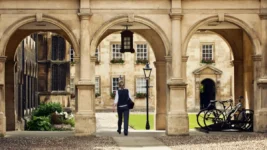
The novel thus unfolds as an allegorical journey through hell that tailors its landscape for each person. For Alice and Peter, both academics, it resembles Cambridge, from its gothic towers to the cloistered courtyards, making Peter blurt out: “Christ, Hell is a campus.” Kuang arranges the circles of hell according to the everyday hazards of academic life: exploitative professors, poisonous gossip, and endless performance of erudition. Hell is not only a metaphysical space but also a real one, complete with libraries, symposia, and departmental politics.
Also Read |
Through this framing of hell, Kuang exposes the corrosive allure of academia, showing how it can consume a person, making the sacrifice of everything else in life for it seem not only acceptable but also necessary. Alice, like most doctoral students, exists in a state of constant exhaustion, induced by too little sleep, irregular meals, and a craving for academic validation. She even takes pride in the days she forgets to eat because they serve as “proof that she had transcended some basic cycle of need. That she was not just an animal after all, held captive by her desires to eat and fuck and shit. That she was above all a mind, and the mind was capable of miraculous things.”
Although often unlikeable, Alice is a compelling protagonist, ambitious and brilliant, yet prideful and stubborn to a fault. From her first meeting with Grimes, whose charisma blinds her to his predatory nature, Alice is caught between awe and self-loathing. She oscillates between fantasies of becoming his intellectual equal and the reality of being objectified, undermined, and ultimately discarded. However, Kuang refuses to portray Alice as either a martyr or a villain. She is complicit in her own exploitation, aware of the dangers yet thrilled to walk on the razor’s edge. “She knew how to walk the line,” Kuang writes. “How thrilling it was to exist in that liminal space between virtue and sin.”
In this way, Kuang captures the paradox of brilliance and suffering in academia: students are victims of the system but also willing participants in their own torment, believing some greater reward awaits them. They become so absorbed in research and theory that the outside world starts feeling irrelevant. In this sense, hell is a perfect mirror to Alice’s and Peter’s growth: as their minds and bodies are pushed to the limit and their teamwork is tested, it becomes a landscape where their ambition, obsession, and perseverance are fully laid bare.
If Alice is all sharp edges, Peter is her opposite. Peter is affable and fawned over by everyone, while Alice can barely make any friends. For Peter, a privately tutored prodigy and the son of professors, success comes easily. In contrast, Alice fights for every scrap of recognition. Their rivalry underscores how academia is not meritocratic but shaped by considerations of gender and class. They are Grimes’ two brightest students, but their paths through the institution are starkly different.
Despite never being present through the journey, Grimes’ presence haunts each page. Kuang paints him with devastating accuracy: the charismatic, abusive male professor who builds his career on the back of students, exploiting their devotion and discarding them at will. In a harrowing passage, after Alice resists his advances, he turns icy, clearing her workstation and keeping her out of projects, demonstrating how easily he can destroy her.
Together they form a triangle that captures the academic machine: the overachiever who breaks herself, the golden boy with immunity, and the professor who manipulates both to benefit himself and uphold the system.
Kuang’s prose is sharp and richly intertextual, layered with references to Dante, Greek tragedies, Chinese mythology, and mathematical logic. This is balanced well by Alice and Peter’s banter, full of wit and dry humour. The novel’s most striking feature, however, is the magic system. Made of chalk, paradoxes, and logic, Magick here is described as “the act of telling lies about the world”. It works by finding loopholes or contradictions, when the rules of reality can be suspended. The physical world blinks as long as the magician sustains the contradiction in their mind, and something impossible happens.
Also Read |
If Katabasis falters, it is in its relentless doubling down on metaphors. At nearly 500 pages, the novel lingers too long in its allegorical landscapes. Kuang does not write a tight plot but a novel full of philosophical tangents; it will bring out the inner nerd in some, but others might find its density wearying. The density might be deliberate though, a comment on the tediousness of academia. Read that way, the readers’ fatigue with the story is a marker of Kuang’s success in driving home her point.
When Alice and Peter finally emerge from the depths of hell, the real world seems more inviting than ever.
To the reader, too, the open air feels cool and fresh after the journey through the suffocating corridors of academia: “Thence we came forth to rebehold the stars.”