
 Booksology
 In a bracing critique of geopolitical cliche, Bilahari Kausikan offers lessons in agency and strategic realism that Taiwan would do well to heed
By Julien Oeuillet / Contributing reporter
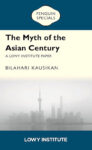
When Bilahari Kausikan defines Singapore as a small country “whose ability to influence events outside its borders is always limited but never completely non-existent,” we wish we could say the same about Taiwan. In a little book called The Myth of the Asian Century, he demolishes a number of preconceived ideas that shackle Taiwan’s self-confidence in its own agency.
Kausikan worked for almost 40 years at Singapore’s Ministry of Foreign Affairs, reaching the position of permanent secretary: saying that he knows what he is talking about is an understatement. He was in charge of foreign affairs in a pivotal place in Southeast Asia. This makes him drastically different from the wide array of academics we are used to reading. Kausikan had his hands in the cogs, and for a journalist it is refreshing to hear the testimony of someone who was actually working on foreign affairs rather than just analyzing them.
A book that includes the word “myth” in its title is obviously going to be a debunker, which is exactly what we need in an era full of speculation. And for an Asian diplomat, Kausikan is not ready to hear any flattery about his own continent. It is no surprise that his book, at its core, takes aim at the tired trope that we are witnessing the dawn of an “Asian century.” He has no patience for platitudes: early in the book, he states that supporting the idea of an “Asian century” by invoking the historical wealth of China and India “sounds clever but proves nothing.”
The other side is not spared either: he has no intention of claiming there is such a thing as an eternally dominant West, or a cast-iron American hegemony in Asia.
This is the best thing about The Myth of the Asian Century: it goes beyond the limits its title would suggest and dismantles other tropes and preconceived ideas that gravitate around it. Let us name a few: the idea that we are in a new Cold War, or that Southeast Asian countries (or any country, for that matter) are aligning entirely with one superpower simply because they make a trade deal with one or conduct a military exercise with the other. This may disappoint audiences who hope to grasp the reality of Asia (or the world) with simple slogans. Sadly for them, the world is very complicated. Luckily, this little book explains it in a simple and accessible style that also occasionally becomes very funny.
‘POLITE TRANSACTIONALISM’
A good example is how Kausikan points out that Trump’s foreign policy is not so different from that of his predecessors, especially when it comes to Asia. He writes that they are “more alike than any of us would be comfortable admitting,” adding that when Biden’s diplomats talked politely to countries in Europe and Asia, it was not “to inquire how our families were doing (but) to see what we were prepared to do to advance American interests,” something he calls “polite transactionalism.” We can infer that Trump practices “rude transactionalism.”
The implications for Taiwan are multiple. From the first chapter, Kausikan explains that those who claim the rise of an Asian century really mean a Chinese century, to the exclusion of the rest of Asia, reduced to a Chinese backyard. He makes it clear that this trope is simply a variation of Chinese leader Xi Jinping’s (習近平) favorite slogans that China’s rise is inevitable, or that “East is rising and West is falling.” Hence the existential need for Taiwan to strip down and expose this trope for the fake intellectualism it is.
‘BINARY TRAP’
The book is also seminal for anyone in Taiwan who understands the importance of Southeast Asia and ASEAN for the continuity of the country’s independence. Kausikan denounces what he calls the “Binary Trap”: the tendency among analysts to believe a country (particularly in ASEAN) must be siding either with China or with the US. While acknowledging that China is too big to be ignored, he explains that engagement does not mean alignment. Conversely, although most countries in the region cannot imagine Asia without an American presence, this does not make them pro-US per se.
This “Binary Trap” is prevalent in Taiwan, where anxieties create fertile ground for knee-jerk reactions to our neighbors’ dealings with either power. This is understandable, but it ultimately clouds our judgment. As Kausikan clearly states, in Southeast Asia, when it comes to China and the US, “none are entirely trusted” and “they are trusted and distrusted for different reasons in different domains.”
This insight is key to understanding our neighborhood and safeguarding our own interests and sovereignty. Kausikan even quotes novelist F. Scott Fitzgerald, noting that “Asians have no difficulty holding two or more opposing ideas,” which he calls “a deeper insight into Asian statecraft than many political scientists and experts on the region.”
If Taiwan wants ASEAN countries on its side, it must accept, as Kausikan writes, that “it is futile to force attitudes into a consistent pattern.”
Kausikan takes the Quad as an example, showing that, in Asia, this US-led group is often more popular than the US itself. He does not see an Asia without America, but that does not mean an American Asia.
He also compellingly demonstrates that nationalism has been the strongest force shaping Asian politics, preventing a Cold War-style ideological alignment. Despite strong Chinese cultural influence, countries such as Korea, Japan, and Vietnam define their nationalism partly through opposition to China. He explains that the world is moving toward fragmentation rather than unity, and in passing dismantles the myth of a homogeneous “Global South,” which he describes as little more than a “mood.” These countries pursue their own interests rather than those of a hypothetical Chinese-led Asia.
Taiwan is an outlier if it still believes the world to be strictly binary. The lessons in this book are enough to reassure us that, like the author’s native Singapore, we are a small country with agency in a complex and fragmented world whose history is still being written. It is no surprise that we breathe better after reading it.
Publication Notes
The Myth of the Asian Century
By Bilahari Kausikan
123 pages
Penguin Specials — Lowy Institute


