 Booksology
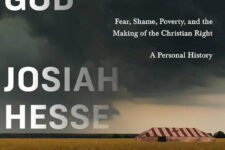
 Opening with visceral imagery of crying, flailing children on the floor of a church, Josiah Hesse’s On Fire for God: Fear, Shame, Poverty, and the Making of the Christian Right (Pantheon Books) sets itself up to be an emotional and unflinching interrogation of evangelical Iowa.
The book follows a religious childhood using gorgeous, descriptive language to explore Hesse’s home and church experiences (which somehow manage to feel both universal and horrifying). Through this lens of rural, evangelical Iowa, Hesse tracks and humanizes the Christian right while detailing his own deconstruction journey — a “rebuttal” to J.D. Vance’s Hillbilly Elegy by way of Tara Westover’s Educated.
I was excited to learn about the Christian right experience through the lens of an Iowan ex-pat. I want to understand how I came to feel at odds with my state. Hesse delivers on this front with lived-in details, like how each morning his high school (composed of 4th through 12th graders, about 35 students) would pledge allegiance to the Christian flag. “I pledge allegiance … and to the Savior for whose Kingdom it stands; one Savior, crucified, risen and coming again with life and liberty to all who believe.”
On Fire for God did give me a better perspective on how so much seems to have changed between political parties in the last decade, but it also provides insights into how each of us responds to the path laid out before us. Early in the narrative, Hesse establishes his church and his parents’ backgrounds as devotees of “prosperity gospel.” The idea of the prosperity gospel is that if you believe in and serve God well enough, success and wealth will follow, and that in order to entice and save more souls, you should look and act above your means. Hesse builds the scaffolding for the reader to understand where he comes from and, because of this, we better understand him and the people he loves. Like him, we “(wonder) how many people out there were living lives of quiet desperation.”
I was relieved to see my conservative neighbors and kin treated with empathy and not shrunken into caricatures. It was easy to fall in love with Hesse’s parents and childhood best friend because I know versions of them. At one point, Hesse describes his best friend by saying, “Like so many Iowans I knew, Thad often became embarrassed when he revealed any sort of passion or ambition,” a line which struck me as a near universal descriptor of my own family.
The combination of vivid storytelling (so good that, because I was in Hesse’s shoes, I was surprised when his friend made transphobic comments) and research conveyed conversationally makes this social-commentary-memoir hit particularly hard. I wanted to protect young Josiah from the horrors he found in his fire-and-brimstone religion.
Hesse’s honesty and vulnerability through this memoir are admirable. It’s hard to shake the self-hatred that sprouts early in childhood when one’s own thoughts are the enemy. Owning the anxiety and ethical questions he still faces as someone who grew up queer, curious and shy in an evangelical environment cannot be easy.
But Hesse is curious. “Curiosity has no agenda, narrative, or ideology. It is never completely satisfied; always hungry for new perspectives, new information and that makes everything infinitely more complex, yet endlessly fascinating.”
This article was originally published in Little Village’s March 2026 issue.