
 Booksology
 “No Place Like Nome: The Bering Strait Seen Through Its Most Storied City”
By Michael Engelhard; Corax Books, 2025; 306 pages; $24.
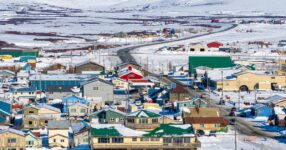
Nome seems both unlikely and inevitable. Perched on the Seward Peninsula, it’s the westernmost sizable city in Alaska and the United States. Spawned by a gold rush, it somehow survived the frenzy despite its location, which can only be called remote.
And yet, in deep time it’s hardly remote at all. The region was once a way stop along the Bering Land Bridge, the pathway through which humans migrated from Asia to the Americas. As water levels rose and the continents broke apart, interlinked cultures continued trading across the waters. And except for a few short decades during the Cold War, barely a blip on the timeline since people arrived, it has remained a crossroads ever since.
Nome itself is barely 125 years old, but beneath it lies a vast history, one that longtime Alaska author Michael Engelhard scratches the surface of in his latest book. “No Place Like Nome” is a meandering but thoroughly engrossing collection of observations and explorations that wander along the streets of the small outpost and then outward, far beyond the city limits.
“Few environments that are not wildlands have inspired me so as a writer,” Engelhard tells us in the first paragraph of his book’s introduction. And across some 300 pages, he shows us why.
“No Place Like Nome” is not a history in the formal sense, and Engelhard makes little to no effort at offering such a narrative. A writer who is at his best when using the essay as his form, he sets a general theme with each chapter, and then lets his account follow his mind wherever it goes.
But first he sketches the scene, providing readers who perhaps have never been there with a striking sense of what it means to live in Nome. Through a cascading series of memorable sentences, he takes us on a spiraling tour of all that follows.
The city sits so precariously upon the shore, he writes, that “It’s a farmer’s blow away from sliding into the sea.” The air abounds with such constant movement that “If the wind ever stopped, you’d do a face plant.” The region’s polar bears are “white ghosts on plate-size paws.”
And on he goes. Engelhard is a wordsmith with few equals among Alaska’s many talented writers. Were it not for copyright considerations and lack of space, I’d simply submit the entire introduction for a review and leave it at that.
Engelhard, a naturalist at heart, can’t help but look to the lands and flora and fauna found on them in the chapters that follow. But in what amounts to his first book focused primarily on humans, he explores how they have, for untold centuries, availed themselves of animal and plant life. Most of that time by the necessity of survival, more recently through the luxury afforded by spare time and imported food and goods.
And so the first formal chapter leads us to the long-extinct wooly mammoth, once found from Europe to North America. Stalked by ancient generations of humans, many surmise that such predation is what drove the beasts to extinction. Yet it lingers still, its remains emerging from the ground upon which descendants of those early carnivores now walk.
This is the farthest back Engelhard travels, but in subsequent chapters he frequently ties his topics to the land. Thus we learn about foul-smelling wild sage, seen as a medicinal herb. We visit with weavers who collect qiviut, the soft under wool of musk oxen, the warmest natural fiber on Earth. The clothing that was necessary for protecting bodies, crafted from skins and fur, is dissected. And we find out that jade, unlike gold, held tremendous value long before Europeans arrived on the scene.
(Book review: Author Michael Engelhard follows the beating heart of Alaska in collection of essays)
In other chapters, Engelhard introduces us to some of the often eccentric people who found their way to Nome and left their mark.
The controversial but crucial Edward S. Curtis concluded his vast 20-volume photographic collection “The North American Indian” with a journey to Western Alaska in 1927.
Naturalist Sally Carrighar showed up midcentury and shared her home with an assemblage of lemmings that she studied, but not with fellow humans, who she’d long since learned enough about.
The Inupiaq hunter and trapper James Kivetoruk (Kivitauraq) Moses, forced by injury to abandon his vocations, became a world-renowned artist whose paintings depict the life he witnessed on the land.
The famed Norwegian polar explorer Roald Amundsen visited twice, initially in 1906 at the close of his pioneering journey through the Northwest Passage, and then again after traveling as a passenger aboard the Norge, an airship held aloft by hydrogen that passed over the North Pole on its 1926 aerial trek from Spitsbergen to Teller.
And of course there’s Nome’s founding days, evoked early in the book before Engelhard moves on to other topics of equal — if not greater — importance.
“Rome wasn’t built in a day, but Nome almost was,” Engelhard tells us in a breathless chapter about the town where America’s Wild West played its last hand. Amid a deluge of highly quotable lines, he provides an anecdotally-detailed description of the manic gold rush that birthed a ragtag city on ground that was almost barren a year earlier. The collective madness, he explains, “resembled a page from one of those I-Spy busy picture books, with the search object being sanity.”
Anecdotally-detailed is a good way to describe the earliest pages of this book, which fly by in an almost Kerouacian manner. Engelhard alights here, there, and elsewhere, his approach a bit dizzying. But the effect is to highlight how complex this seemingly simple place is.
Then he slows down and digs deeper, including along the way sepia-toned photographs not simply illustrating his account, but expanding it. He doesn’t so much offer the totality of the place as simply convey that such a goal would be impossible for even the best writer.
Nome, Engelhard writes, is especially suitable “for people with a romantic streak.” His book proves his point.
(Homer author’s new book puts facts and stories about Alaska glaciers at your fingertips)
(Book review: Episcopal priest shares a soul’s journey through a life of faith in Alaska)
(With 50 years writing about Alaska’s environments and landscapes, Debbie Miller has crafted a rich legacy)


