
 Booksology
 I have always had an interest in the creative for as long as I can remember — from writing short stories as a young girl, to angsty poetry as a teenager, to writing reviews as an adult and poetry that flits between depth and silliness. Because of that, I am far too familiar with writer’s block and lack of inspiration.
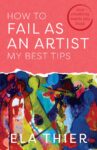
So, as someone who has found themselves in that space many times over the years and as a self-confessed bookworm, it’s fair to say I’ve read quite a few books about creativity and the idea of ‘waking up the muse’. When I read about How to Fail As An Artist, I was immediately intrigued. It felt like it was coming from a slightly different place than books like The Artist’s Way (which, don’t get me wrong, is an amazing book that I highly recommend for anyone on a creative path). Ela Thier also openly shares that she was inspired by Big Magic-another familiar favourite but brings her own distinct voice to the conversation.
Straight off the bat, what I loved about Ela Thier’s writing is how down-to-earth and conversational it feels, like a friend talking you through something rather than instructing you. There’s a lightness and humour running throughout that makes the book not just helpful, but genuinely enjoyable to read.
One of the most engaging aspects is how she brings her internal creative struggles to life through characters. ‘Mr. Stop’, a sock puppet whose sole mission is to derail her from writing, will feel instantly recognisable to anyone who has ever tried to start (or finish) a creative project. That voice that whispers “wouldn’t you rather scroll through Instagram?” or insists you’re an imposter has never been more accurately captured.
But it’s not all resistance and self-doubt. There’s also ‘102-year-old Ela’, her future self, who offers wisdom, encouragement, and a much kinder perspective. Lines like “that’s your job as a writer — to open your skull and invite people in” feel both slightly surreal and completely true. Her advice to “follow the fun” — to create from a place of joy rather than overthinking really stood out to me. It’s a reminder that creativity doesn’t have to start with perfection or analysis; it can start with simply doing, playing, and seeing where it leads.
The book blends encouragement with memoir, weaving in Ela’s own journey as a writer, director, actor, producer, and founder of The Independent Film School. Hearing about her path adds another layer to the book, making it not just about creativity in theory, but creativity lived and experienced over time. Her approach, particularly to teaching, feels rooted in honesty, experimentation, and permission to try — something that feels incredibly valuable in a world that often demands polish straight away.
How to Fail As An Artist feels like it would resonate with both beginners and more established creatives — whether you’re just starting out or simply need a reminder of why you started in the first place. It’s the kind of book you can return to whenever you feel stuck, disconnected, or in need of a gentle push forward.
Yes, it may have been inspired by books like Big Magic, but Ela Thier delivers her message in a way that feels grounded, playful, and refreshingly real.
Ultimately, this is a book that reminds you that creativity doesn’t have to be perfect — it just has to be honest, and, most importantly, it should be something that brings you joy.
Ela kindly took the time to answer some questions about the book, and honestly her answers have just made me love her and the book even more.
You describe ‘How to Fail as an Artist’ as your own response to books like Big Magic, what did you feel was missing from existing creativity advice that you wanted toadd?Ela: Nothing was missing; I loved Big Magic. If you watch a comedy buddy film, and it inspires you towrite a comedy buddy film, it’s not because anything was missing in it. Each person who feelscompelled to write a comedy buddy film, if they wrote authentically, would deliver somethingunique, because their mind and history is unique.My litmus test for what makes a work of art truly great, is if it inspires others to create as well.When I see a painting I love, it makes me want to paint. I read a book I love about creativity, soit inspired me to write a book about creativity.
The idea of ‘failure’ is central to the book, what does failure mean to you creativelynow compared to earlier in your career?Ela: In the past I was more preoccupied with external measures of “failure” and “success”. Today mymeasure of success is whether I’m creating work that I love, with people I enjoy working with.
Mr. Stop feels instantly recognisable, do you think that voice ever fully goes away,or do we just learn how to work alongside it?Ela: That voice is not inherent to being human. It gets planted there by a society that is organizedaround profits rather than human needs, and therefore it must either stunt creativity, or profit offof it. If everyone’s creativity thrived, we would work together to create a society built aroundcompassion and foresight. The voice of “Mr. Stop” (the inner critic), is a symptom of living in anoppressive society.So does it ever fully go away? Under the current conditions, and in our present societies, no. Idon’t think it can. Some of us can pretend it’s not there, but it still lurks. If anything, the pretensegives it more power of us.The only way to make it fully go away, is by building societies that are focused on human needsrather than greed. That alone will make this voice go away – for everyone.Put differently: making the voice of the Inner Critic go away is not an individual project. It’s acollective project that we must take on together.
On the flip side, the ‘102-year-old Ela’ offers a very compassionate voice — do youthink creatives need to actively build that kinder inner voice?Ela: That wiser inner voice is one that we all have. We don’t need to build it, we need to find it andlisten to it.For many years, whenever I would get stuck, I would freewrite conversations with “future me”.These freewrites would help me find, cultivate, and benefit from those parts of my mind thathave clarity and lack all insecurities.
You talk a lot about ‘following the fun’, how do you balance that with the disciplineneeded to actually finish creative work?Ela: Discipline is incredibly fun. Not doing your best work is quite boring, actually. Writing this bookwas hard work, but some hard work is extremely fun.Many things are fun. This week I had fun playing baseball with my 9-year-old nephew; making alentil dish that I’ve never had before; getting up at 5am every morning to work my butt off on anew screenplay. All of these were fun.
Do you have any rituals or habits that help you move through creative blocks?Ela: Freewriting is a tool I use regularly. Lose the fear of putting words on the page and letting thewords come is a muscle you can practice and build with time. I use freewriting as a way to buildand maintain that muscle.But more importantly – writing alongside other people and involving people in your work, is thebiggest antidote to writing blocks. Tomorrow morning I have a writing date on zoom at 6 in themorning with a student of mine. We get on zoom, check in with each other, then do our ownwriting.Have a writing block? Schedule a reading and invite people to it. You’ll get the writing done bythat date one way or another, because you just involved people in your work.It takes as much creativity in figuring out how to involve people in your work as it takes to do thework itself.
How has running The Independent Film School shaped the way you think aboutcreativity and failure?Ela: I used to think that I wanted to create films that spur hope – that remind audiences of the best ofhuman beings – that remind audiences that we’re caring, generous, funny, spunky, generous,creative. Building a film school helped me see that everyone else wants the same thing. Inviteand encourage other artists to use their talents for the good – and they line up wanting to signup!
What’s the most common thing you see holding people back creatively?Ela: Internalized oppression is what holds us back more than anything else. If you were raised as afemale, you absorbed misinformation about your intelligence and abilities. If you’ve beentargeted with racism, it left you thinking that you’re not important, and that there is no hope foryou. If you’re gay, Jewish, Muslim, physically disabled, have parents who worked with theirhands – if you’ve ever been a child for that matter – you absorbed lies about your abilities andsignificance. This has held you back more than you know.
What’s something you still struggle with creatively, even now?Ela: Most artists, and most art work, doesn’t make money. That’s not because the work isn’tinherently valuable. It’s because systemic oppressions ensure that artists remain exploited; weare either underpaid or not paid.One of the many struggles that I, and so many artists battle, is being under-resourced. I oftenjoke in saying that artists are a lot like parents: the harder we work, the less money we have.Most artists need a day job, to keep the lights on, and separately from that, we need to find thetime, energy, mental bandwidth, and resources, to create the work that we’d like to create.I get up at 5am to work on my writing. My day job (running The Independent Film School) thentakes up most of my waking hours. And here I am, at 11pm, answering interview questions!Creative work requires a lot of time that artists simply don’t have. This can’t keep us from doingthe work we want to do, but it sure as hell makes it a lot harder.
What does ‘success’ as an artist look like to you today?Ela: Doing work I care about, with people I enjoy working with.If I do that much, I’m a big success!
You can buy How To Fail as an Artist here
Website: theindependentfilmschool.com/ela-thier/
The Independent Film School: theindependentfilmschool.com
IMDb: Ela Thier
Instagram: @elathier
Facebook: facebook.com/elathier
YouTube: www.youtube.com/@elathier
Review by Hayley Foster da Silva
Keep up to date with all new content on Joyzine via our Facebook | Bluesky | Instagram | Threads | Mailing List


