
 Booksology
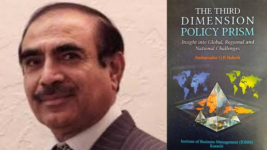
 I looked critically at The Third Dimension Policy Prism Insight into Global, Regional and National Challenges from practically all angles, including the themes chosen for the articles very current and under constant and persistent debate and analytical exercise all over the world and too important to be ignored in Pakistan by scholars of international relations; the arguments advanced to draw convincing conclusions; and the suggestions made to address challenges stemming from fast-changing geopolitical and geostrategic dynamics at the regional and global levels.
Above all, the careful selection of words and phrases to elaborate complex and enigmatically entangled international issues deserves appreciation. A commendable task has been done with a sense of perfection by an expert in the subject and a skilful writer. The author, Ambassador Ghulam Rasool Baloch, appears to possess this qualification and calibre.
I found the book highly insightful. No doubt, one may disagree with the author’s views, but one cannot deny him the credit for his scholarly approach, intellectual hard work, and thorough analysis of international and regional issues with far-reaching consequences for smaller countries like his own land, and for international peace and security—critically significant for the human fraternity.
Ambassador Ghulam Rasool Baloch has served in various positions in Pakistan’s missions abroad and at the Ministry of Foreign Affairs for over three decades. As a knowledgeable diplomat, he never severed his bond with books and the pen. Like most diplomats, he also developed a natural and keen interest in matters of greater importance to the international community that aspires to peace and harmony on this planet. Diplomats have a difficult task to perform in foreign countries and cultures. They pick up rainbow colours from their interactions with the citizens of the countries of their accreditation and with their colleagues in the diplomatic community. At the end of their tenures, they move to another country and continue adding to their rainbow colours.
Thus, all diplomats tend to harbour a sense of international citizenship with faith in internationalism, humanism, and human fraternity. Ambassador Baloch has not been an exception to this stimulus. This has shaped his views on international issues and turned him into a thorough thinker and a prolific writer on international affairs that could contribute to promoting peace, security, and harmony in this world, the common home of the human community, notwithstanding its division into sovereign nations and states.
The trajectory of international relations over the coming two decades will be shaped by the level of understanding or intensity of confrontation between the United States of America and the People’s Republic of China
The Third Dimension Policy Prism is his second book on international affairs. His first book, Duty to Pen, was compiled a few years ago and was well received among diplomats, teachers, and students of international relations, which most probably motivated him to resume writing on his favourite subjects. He produced a substantial number of articles within a year or so to compile this highly commendable anthology. Thus, here we have a significantly researched, well-argued, and well-written collection of essays contained in The Third Dimension Policy Prism for readers, researchers, teachers, and students. It is an interesting and insightful read.
Keeping in view the convenience of his readers, Ambassador Ghulam Rasool Baloch has broadly divided the book of over 400 pages into five chapters: The South Asian Region, The Middle Eastern Region, The Global Powers, Global Politics, and finally the Academic and Social Issues confronting his dear country. He has categorised and assembled all relevant essays under these chapters.
Just a glance at the contents gives an idea of the scope and reach of the book, which deals separately with issues of concern to the South Asian and Middle Eastern regions, the competition and confrontation among global powers at the international level and across regions, and the currents, cross-currents, and undercurrents of global politics posing perennial threats to the international order and involving smaller countries as pawns.
Ambassador Baloch has not been oblivious to the challenges and issues confronting his dear land. However, he has carefully kept clear of polemics or the touchy political and economic controversies surrounding Pakistan’s hazy horizon.
This is not a book dealing with a single chosen subject, researched with references to already published works of scholars to prove a particular point of view or reach a scientific conclusion, as in the natural or social sciences. However, anthologies based on essays and columns written with scholarly grit, understanding, and knowledge stimulate streams of thought and advance convincing lines of argument that prognosticate the future course of competition, confrontation, and conflict in global and regional affairs—if the circumstances and conditions surrounding conflicting interests remain constant.
Such analytical assumptions underpin theories such as Thucydides’ Trap, the Clash of Civilisations, Deterrence through Mutual Annihilation, Balance of Power, Power Equilibrium between States, and the practical significance of the Treaties of Westphalia in determining the principles of state sovereignty and equality of states that shaped modern international relations. These were later reinforced by the Non-Aligned principles adopted at the Bandung Conference held in April 1955.
Following the current trend of competition and confrontation among powerful countries, one can confidently claim that the trajectory of international relations over the coming two decades will be shaped by the level of understanding or intensity of confrontation between the United States of America and the People’s Republic of China.
I believe that my batch-mate and former Interim Foreign Minister, Jalil Abbas Jilani, has done justice to the book by inviting readers to view world politics not merely as a contest between states or major powers, but as a moral enterprise shaped by human choices. Ambassador Baloch navigates seamlessly across continents, dealing with multiple crises—from South Asia’s struggle with ideological nationalism to the Middle East’s perpetual search for justice; from the shifting equilibrium of Eurasia to the rise of new economic and technological multi-centres. Each essay offers a prism through which readers can gauge both the complexity of events and the enduring human aspiration for peace and security.
As rightly observed by the author, the twenty-first century has confronted the international community with profound paradoxes. Nations have witnessed an age of unparalleled technological advancement, yet they face growing moral decay; they have conquered distances but failed to bridge divisions. In such a world, objective, disciplined, and humane analysis is more than an intellectual exercise; it is a social service rendered to the international community, piercing the darkness spread by falsehood, misinformation, propaganda, narrow nationalism, ideological prejudice, and populism.


