
 Booksology
 This past spring and summer I took the Vermont Bookstore Tour, a series of daytrips that led me to 20 indie bookstores around the state — starting with Bear Pond Books in Montpelier, Next Chapter Bookstore in Barre, and Bridgeside Books in Waterbury. It was a terrific staycation that I highly recommend bibliophiles consider.
At every stop, I checked out the omnipresent Vermont section, which always focused on books, but sometimes included other Vermont-themed items, from clothes to jigsaw puzzles. In every store, the “Vermont Almanac” series was the most commonly promoted of the Vermont books.
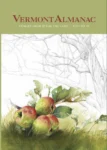
Edited by Dave Mance III and Patrick White, “Vermont Almanac: Stories from & For the Land, Volume VI” (For the Land Publishing, Corinth, Vt.) recently hit bookstores, and once again, the cover and the paintings, drawings, and photography inside make it hard to put the book down.
This year’s cover, by East Montpelier artist Susan Bull Riley, is a watercolor painting of apples on the ground in front of the gnarly old apple tree from which they fell. Inside, are several seasonal paintings by Heidi Broner of Calais, along with illustrations, historical paintings, and about 170 well-chosen photographs. The book is a visual treat, even before you begin reading.
As in the past, Volume VI takes readers through the year, from fall through summer, with features, articles, stories, and poetry. Organized by the season, rather than by month, as it was previously, the book has sections: Weather, with articles like “Summer 2025 in a Few Words: All Dried Out”; Nature Notes; Skills, with articles about such things as making chanterelle pasta, wild garlic ramp ketchup, or indigo dye; and A Look Back, including the 1810 story of Glover’s runaway pond.
The editors note that they have been less directive in their editing, with the intent of letting each writer’s voice shine through more clearly. Often, that means a more casual, easygoing style. Mance’s “Glastenbury and the Importance of Wild Places” opens the book and sets that tone.
“I grew up in southern Vermont and have something of a chip on my shoulder about that fact, a relic of a lifetime of enduring is-that-Vermont-down-there? cracks from people who live in other parts of the state. It’s all fun and games when we’re poking fun at New Jersey, but there’s a cohort of people who find it high wit to turn the barbs inward.
“Once a storekeeper in St. Johnsbury asked me where I was from, and when I told her Shaftsbury, she said she considered everything south of Route 4 to be part of Massachusetts, and everything west of Route 100 to be part of New York, which would mean that I live in both of those states. And so I told her that I considered everything east of Route 100 to be New Hampshire and everything north of Route 2 to be Canada.
“I didn’t actually say that, but thought of it afterwards, like you do. My heart goes out to Chittenden County, which is the one place that gets more of these snide remarks than we do.”
As the title suggests, storytelling is central. Visits to the Junction Fiber Mill in the Upper Valley and Clifford Lumber in Hinesburg focus on the people behind them. Readers learn a lot about snakes in “A Guardian of Milksnakes,” a fascinating story of a family that chooses to let wild, nonvenomous snakes live in their house. Brett Ann Stanciu’s “I Could Live Here” is a moving story about facing stage four cancer.
The 35 contributors, all from Vermont, include some big names, like Julia Alvarez, who writes about weeds, gardening, and her husband’s suggestion that even though she’s smart enough to write books, that doesn’t mean she’s a good gardener.
Particularly timely for this time of year is Sydney Lea’s “Winter, or, Tempting the Lord.” The former Vermont poet laureate and author of 27 books, begins in February, his favorite month of the year — “in good weather” — and offers some perspective on modern life in the telling of stories of two old-time Vermonters.
Like previous volumes, “Vermont Almanac, Vol VI,” is still 7×10”; however, it is slimmer (184 pages), with a correspondingly slimmer price ($25). The cover and the interior art and abundant photos draw readers in, and the stories keep them there.


