

 Booksology
 Currently, the RCLS Board of Directors is closing several branches of the library in order to “meet new reporting requirements from the Tennessee Secretary of State’s Office.” This vaguely worded post provides little insight into what these reporting requirements are, and the post also does not explain why two branches of the library system would need to close for several days to meet the reporting requirements.
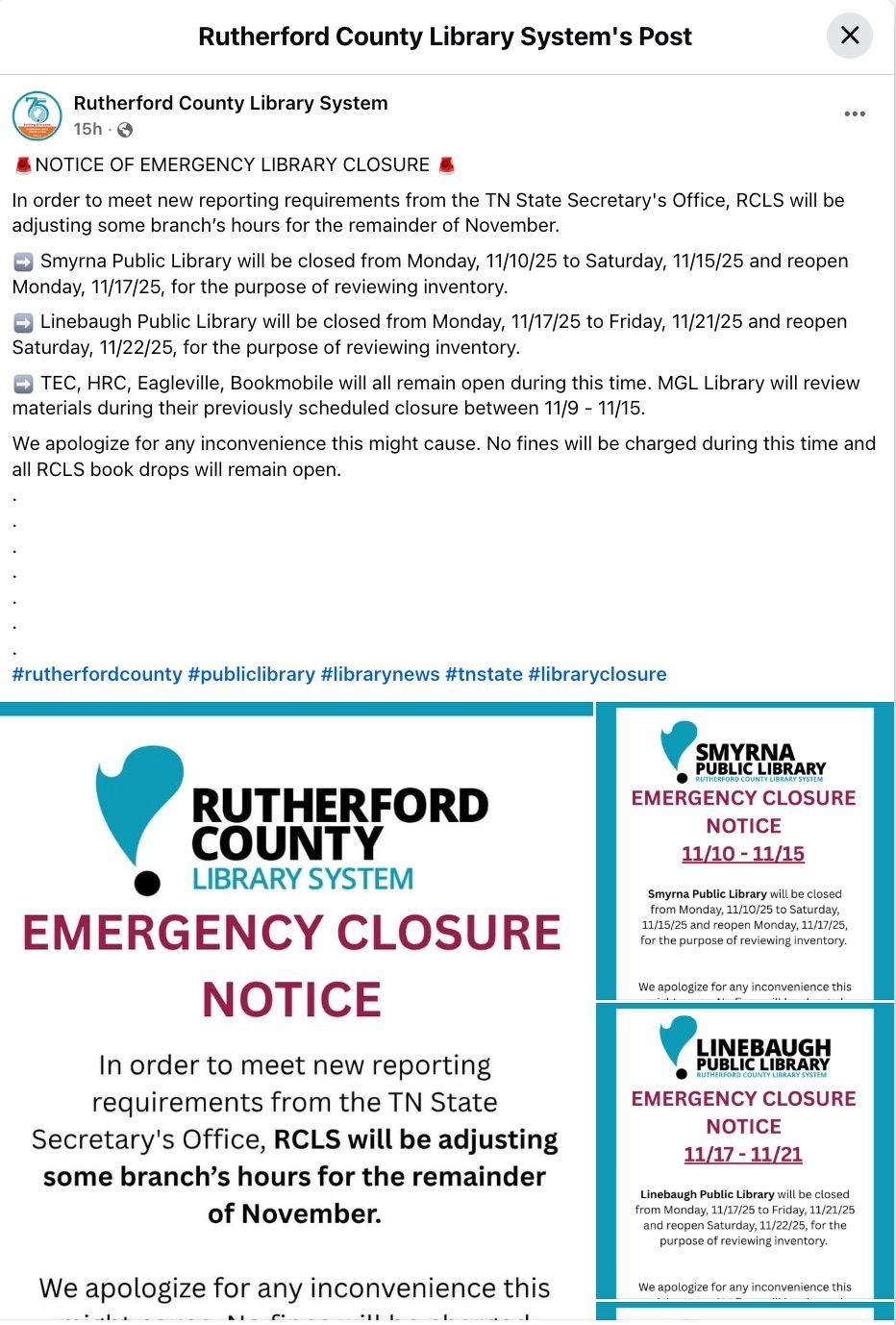
The answer will likely be mass banning of books without public oversight.
literary activism
In addition to the news available, we also include tips and tools to combat censorship and other bookish activities.
Tennessee has been actively updating its statewide library policies since passing the Age Appropriate Resources Act of 2022. In 2024, the law was amended to add more categories of books that are considered illegal by the state. These include books that contain nudity, sexual excitement, sexual acts, and excessive violence. This includes books that appeal to “sexual interests,” including LGBTQ+ people.
Although both of these laws apply to public school libraries, Tennessee has also updated its public library standards, and the language therein mirrors the language of the school-based law. This will likely occur at some point in 2023, and is likely related to a series of laws related to codifying biological sex as the only recognized identity in the state (another library system in Sumner County, Tennessee, also deeply involved in censoring materials, recently failed to pass an anti-trans book policy for the fourth time. 10-3-10). (See page 9 of the .pdf). This is also likely to be a clear over-application of the law.
Page 25 of the 2025 Tennessee Standards for Public Libraries in Community Systems states:
Collection Development Policy (including Material Review Policy)
minimum requirements
- All materials are selected by local public libraries in accordance with each public library’s complete collection development policy.
- A public library’s collection development policy is approved at least annually by the public library’s board of trustees (or equivalent governing body).
- All books selected for purchase by an individual public library, whether through the local library system or otherwise, are reviewed by the public library director prior to purchase, who then shares the list of newly purchased materials with the public library’s board of directors (or equivalent governing body).
- Funds received will not be used to purchase, or otherwise acquired by the Library, materials that qualify as “child pornography,” “minor pornography,” or “obscene.”
- Books and materials with sexual themes or content are independently reviewed by public libraries for age appropriateness and cataloged accordingly, even if this overrides the publisher’s recommended age appropriateness.
- Request for Reconsideration of Materials: The Library has a written, publicly accessible Library Materials Appeals Policy that (a) defines which parties may object or challenge the library’s age-appropriate designation of materials, including at least the parent or guardian of a minor in the library district, (b) defines the process by which material appeals may be initiated, and (c) provides that the results of such appeals or appeals will be disclosed in the public library’s official board meeting minutes.
Starting in September, all public libraries in the state began receiving letters from Tennessee Secretary of State Tre Hargett. He emphasized that in order for libraries to receive funding from the state, they must comply with all state and local laws.
The letter specifically cites President Trump’s “Protecting Women from Gender Ideology” and says all libraries must review their youth materials to ensure they comply with Tennessee’s Age Appropriate Act, all federal laws, and all federal executive orders (which are not legally binding and do not supersede the Constitution).
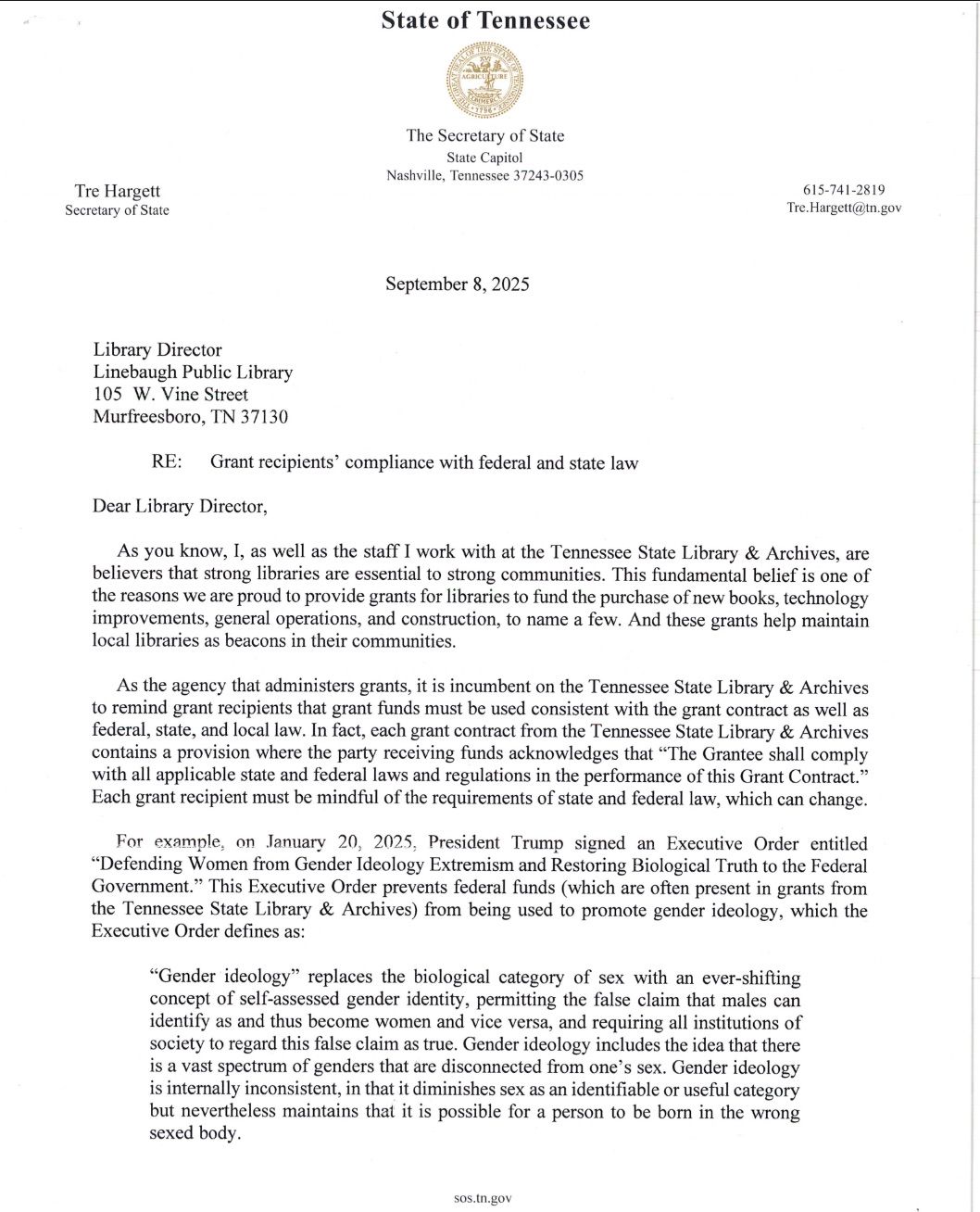
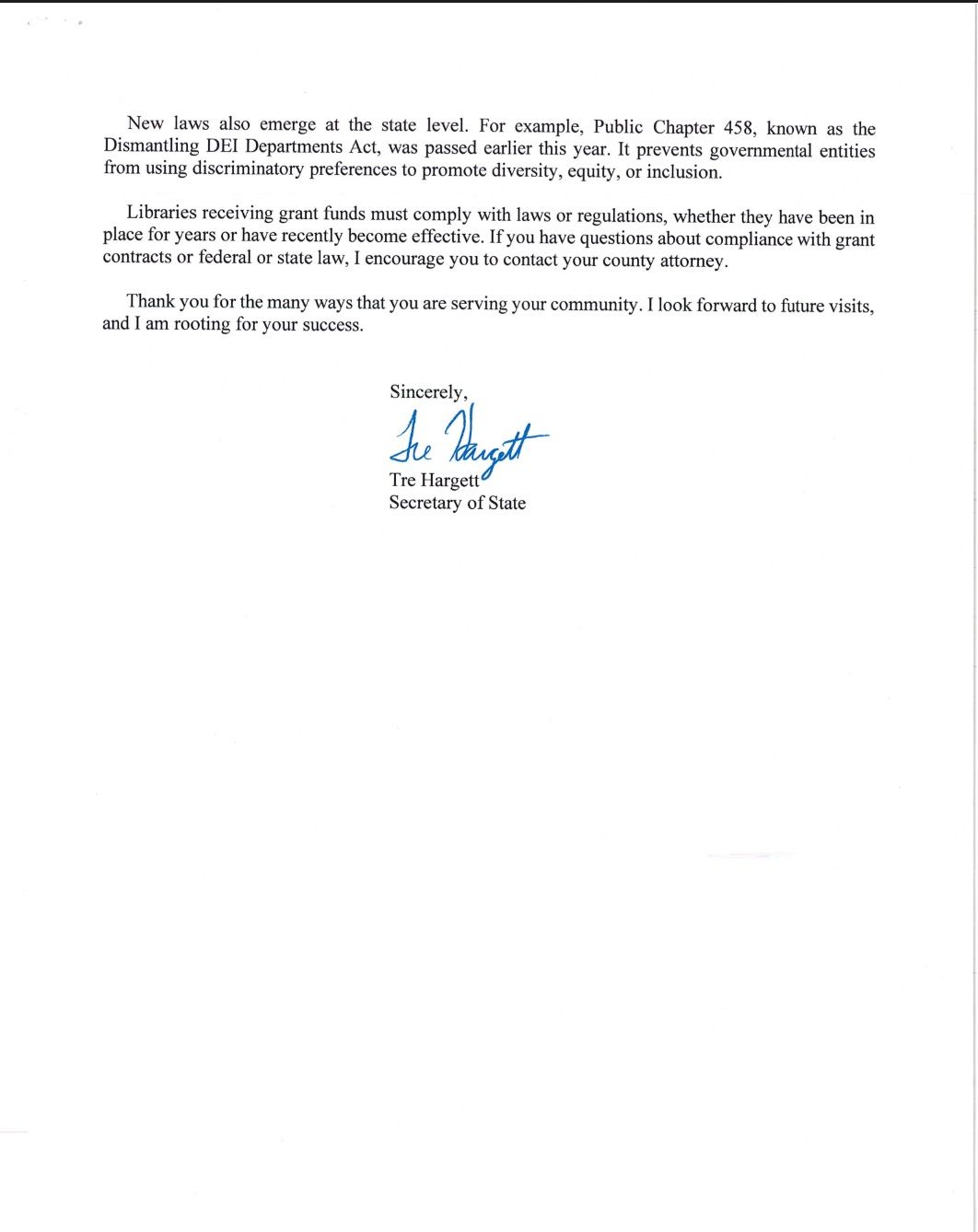
But why is it necessary to urgently close libraries to access materials? This relates to a second letter issued by the Secretary of State in late October, calling for non-compliant books to be removed within 60 days. The RCLS Board Chair, RCLS Director, and Lineborg Public Library Branch Manager received the following.
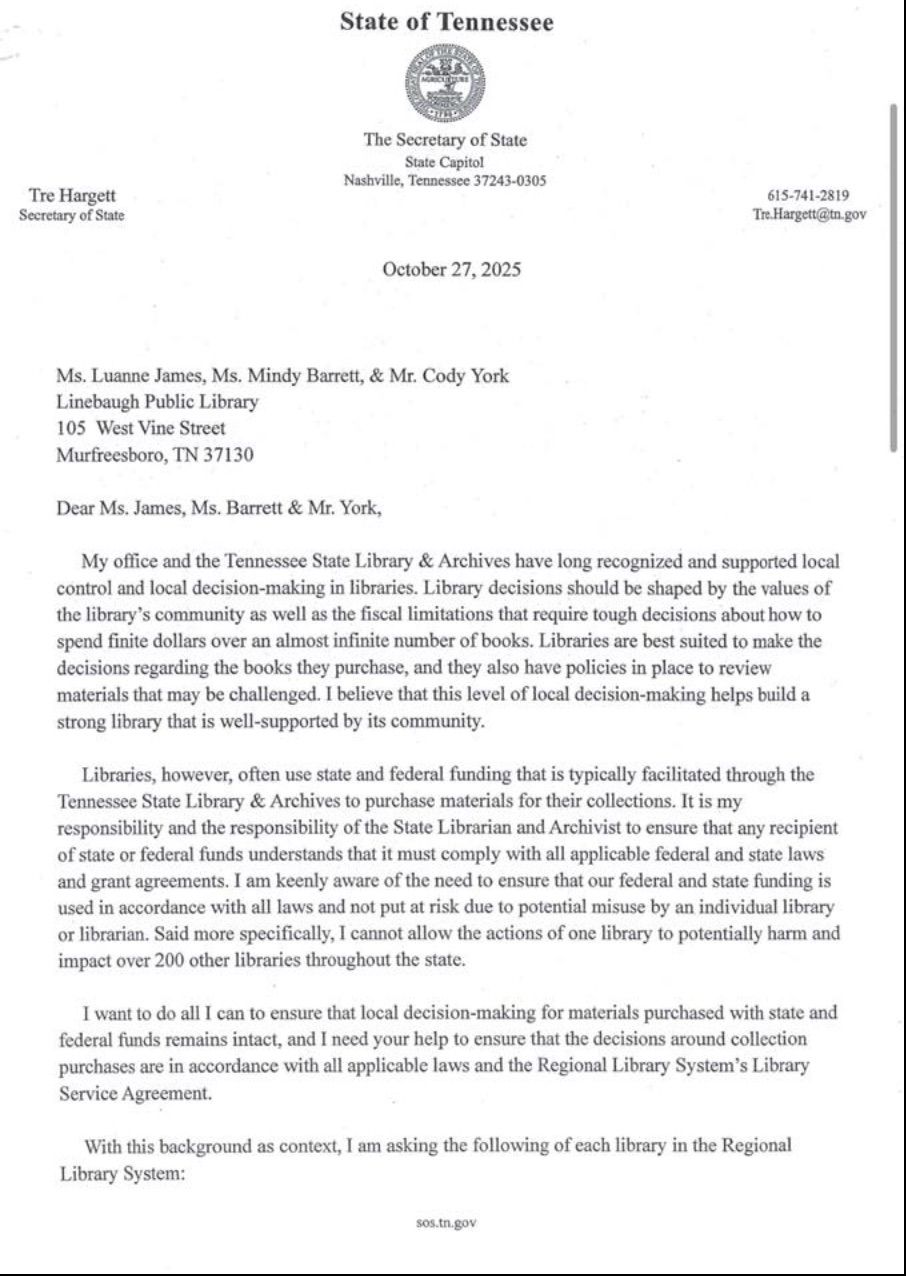
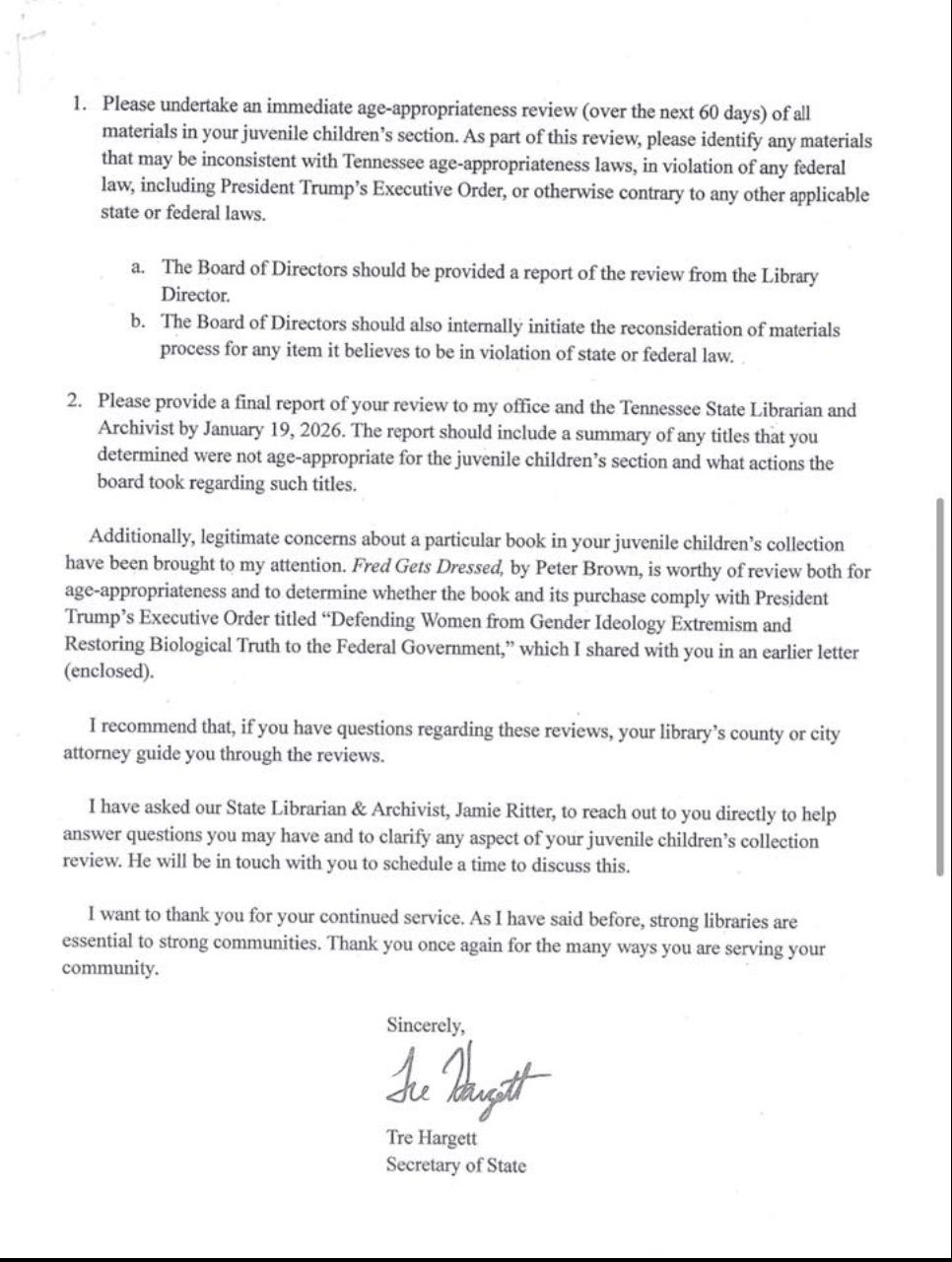
As we saw something similar happen in Florida this summer, the Tennessee Secretary of State is attempting to use its power to force libraries to comply with non-legally binding standards that are certainly intended to lead to wholesale bans. But unlike in Florida, where schools complied out of fear, at least in Rutherford, these demands to remove LGBTQ+ materials from libraries align with the school board’s long-term goals. This is a convenient way to overcome their fear of litigation, which led them to change their anti-trans book policy earlier this summer. If the directive comes from the state, it must be obeyed.
The Tennessee Secretary of State has granted a no-trespass permit to the public library board. This is done in the name of threatening non-compliance, but as we know, other systems in the state, including Rutherford and Sumner County, have sought ways to remove as many LGBTQ+ books from their libraries as possible.
The Rutherford County Library System hired a new library director in June, who is now in a position to field inquiries from residents who wonder why the library is closing two branches for a “review” of its materials. The new director comes from the York County Library in South Carolina, which itself has been subject to a blanket ban on large volumes of books since October of last year.
Rutherford has an active anti-censorship group. They were among the first to raise concerns about potential new changes to library collection policies in late October, shortly before the closure was announced. The Rutherford County Library Alliance will begin organizing response and action in the coming days and will be the first to share updates on library closures. What library advocates can do in addition to following their lead is to keep an eye out for any LGBTQ+ (especially trans-related) books available in the RCLS system. Titles stripped from school districts across the state are likely to be the first targets of this potential purge. If you live locally and can, go to the library this week and borrow any books you think are in danger of “disappearing” from the shelves.


