
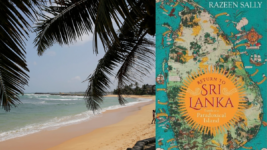
Book Review | History In Motion: Razeen Sally’s Journey Through Sri Lanka’s Past And Present | Opinion News
 Booksology
 Last Updated:July 14, 2025, 12:16 IST
In his book “Return to Sri Lanka – Travels in a Paradoxical Island,” Razeen Sally skillfully blends the narrative styles of George Orwell and Bill Aitken.
Razeen Sally’s book “Return to Sri Lanka – Travels in a Paradoxical Island.”
Razeen Sally’s transition from his traditional academic and policy advisory roles into travel writing marks a significant breakthrough. In his book “Return to Sri Lanka – Travels in a Paradoxical Island,” he skillfully blends the narrative styles of George Orwell and Bill Aitken. The work is both scholarly and engaging, combining elements of history, religion, people, and politics, as Sally explores his Sri Lankan roots. Although raised in England, Sally is of Sri Lankan Muslim descent, with family ties in and around Colombo. He describes himself as “half and half,” born to an Anglo-Welsh mother and a Sinhalese Muslim father, yet he has grown into a Sri Lankan British writer.
The book is divided into two parts: Sally’s Sri Lankan childhood and his adult travels across the island. Accompanied by two trusted drivers, Nihal and Joseph, Sally traverses the teardrop-shaped island, formerly known as Ceylon. His narrative is enriched with quotations from renowned explorers and pioneers of Sri Lanka, primarily British, who once made the island their home.
Sally’s historical account begins with the arrival of Muslim traders from Arabia and Java, who were predominantly Sunnis. His personal recollections start from the 1960s Ceylon to modern-day Sri Lanka. The author’s empathy with the country stems from his experiences with the IPKF, which aimed to subdue ethnic conflict, and his enduring affection for Sri Lankan friends. This bond drew him back to the island repeatedly, retracing familiar paths. Both Sinhalese and Tamils migrated from India, with frequent Tamil Chola invasions from South India. These invasions fostered a paradox: a minority complex among the majority Sinhalese and a majority complex among the minority Tamils. This dynamic prompted the Sinhalese to move their citadel from Anuradhapura to Polonnaruwa, then to Kandy, and finally to Colombo—places Sally vividly describes.
The Sinhalese-Tamil tensions were also influenced by four and a half centuries of colonial rule, which ended with the British period beginning in 1815 with the capture of the Kandyan kingdom. The Sinhalese attempts to reverse their minority psyche are symbolised by two military victories: King Dutugemunu’s triumph over King Elara at Anuradhapura and the defeat of Tamil Tiger leader Prabhakaran’s insurgent forces at Nandikadal by Sri Lankan security forces. The Sri Lankan Army Chief’s office features a portrait of Elara’s surrender.
Domestic racial conflicts were not limited to Sinhalese and Tamils but also involved Sinhalese-Muslim and Muslim-Tamil tensions. The Burgher community largely avoided these conflicts. Sally highlights the distortions in Theravada Buddhism that led to Sinhalese Buddhist nationalism, fuelled by post-independence political leadership. The origins of political parties and their ideological paths for electoral victory contributed to recent history, culminating in the rise of the Rajapaksa dynasty. Following the 30-year civil war, Sri Lanka faced the COVID pandemic, Easter Sunday bombings by indigenous Muslim terrorists, and a 2022 economic meltdown due to a sovereign default. The Argalaya movement and the subsequent fleeing of President Gotabhaya Rajapaksa and Prime Minister Mahinda Rajapaksa mark a sad chapter in contemporary Sinhalese Buddhist politics. Between 2015 and 2018, Sally served as a policy advisor to Prime Minister Ranil Wickremesinghe, gaining insight into the disastrous rule of the first Unity government.
A major irony was the resurgence of the urban Marxist JVP movement, which twice failed to seize power in Colombo, reinventing itself through the Argalaya movement as the ruling NPP. This movement secured a massive parliamentary majority, with the little-known Marxist leader Anura Kumara Dissanayake becoming President. Sally covers Dissanayake’s narrow victory in the presidential elections. At the heart of Sri Lanka’s issues lies the 1978 Republican constitution, which no president or political elite has sought to alter despite promises. Sally’s encapsulation of political history is facilitated by his engaging writing style.
The book’s narration of ancient history, including Buddhism, is equally superb. Few books offer such comprehensive knowledge about a country, seamlessly blending with the author’s travels. Sally describes Buddhism’s arrival from India, the preservation of the Theravada tradition distinct from the Mahayana tradition, and Anuradhapura as the cradle of Theravada Buddhism. He details the Bodh tree sapling from Bodh Gaya in India, where Buddha attained enlightenment, and Buddha’s relics in Sri Lanka—a collar bone, a foot, and a tooth. The descriptions of the world’s largest standing, recumbent, and seated Buddha statues in Gala Vihara are mesmerising.
The travelogue begins in Sally’s hometown of Colombo and its surroundings, followed by trips to the south, including Galle, Tangalle, Hambantota, and Kathiragama, Sri Lanka’s national shrine. The Kandy road takes him to hill areas, tea and coffee estates, and stunning landscapes. He also travels to Rajarata, the original Sinhalese Buddhist kingdoms, ending in Anuradhapura. Sally’s longest journey takes him to the northeast, a region scarred by the civil war. Amparai district, with its significant Muslim population, and Kathankudy in Batticaloa, home to Sri Lanka’s largest mosque, are significant stops. Sally recounts the war and post-conflict situations well, also noting that JVP rebel leader Rohan Wijeweera was captured from a tea estate in 1990 and shot on the 13th tee.
Sally’s prognosis for Sri Lanka’s future is bleak: “Drift, Relapse and Take off.” He believes the country will oscillate between drift and relapse, never achieving take-off. This dire prediction is a harsh truth. Prompted by his driver Nihal, Sally’s journey of Sri Lanka culminates in a self-discovery. The “half and half” Sally realises that his true home is Sri Lanka.
Ashok K Mehta is a retired Lt General of the Gorkha Regiment, Indian Army & Columnist. He writes and speaks extensively on defence and strategic affairs. Views expressed in the above piece are personal and solely that of the author. They do not necessarily reflect News18’s views.
view commentsFirst Published:News opinion Book Review | History In Motion: Razeen Sally’s Journey Through Sri Lanka’s Past And Present


